University Exiled From Hungary By Orbán Reaches Out To New Government
The university forced out of Hungary under Viktor Orbán says it wants to grow again in Budapest. Its leader says the main campus will stay in Vienna.
BRUSSELS, Nov 14 – Central European University, which moved most of its work out of Hungary under pressure from former Prime Minister Viktor Orbán, is open to expanding its presence in Budapest, its interim president and rector said.
Carsten Q. Schneider said in an interview that the university wants to offer more programs in the Hungarian capital, as long as the change does not harm the student experience.
The university has not yet held formal talks with Hungary’s new government, which has promised to restore academic freedom. Schneider said both sides are reaching out, but noted that the new government has many other tasks on its plate.
Central European University moved its main activities from Budapest to Vienna in 2019, after a long dispute with Orbán’s government. The outlook shifted in April, when Péter Magyar won a landslide election victory on a promise to fight corruption and reform the state.
Magyar’s Tisza party secured a supermajority in the 199-seat National Assembly, prompting Prime Minister Viktor Orbán to concede defeat, according to reports at the time.
The university was founded in 1991 by George Soros, the Hungarian-American financier and philanthropist, to support democratic change in the region. It was forced to stop awarding degrees in Budapest because of a law that was widely seen as aimed at the institution.
The Court of Justice of the European Union struck down that law in 2020. The court found that it breached the European Union’s Charter of Fundamental Rights, but the ruling came too late to keep the university in Hungary.
Today, Central European University still has 312 employees in Budapest, most of them in administrative roles. Its larger team of 476 people, along with all of its teaching, is based in Vienna.
Schneider said a stronger role for the privately funded university in Budapest would be a symbol of academic freedom and resilience. But he said it would depend on goodwill and on money that does not come from the Hungarian government.
Any decision on the university’s future in Hungary will be made by its 13-member board. George Soros and his son, Alexander Soros, both sit on the board.
“We don’t want special treatment,” Schneider said. He added that the university is a great asset and that both sides should be able to work something out.
Still, a full move back to Budapest is not planned. Schneider said the university is thriving in Vienna and that any change would have to protect the quality of its programs.
He said students should, for example, be able to combine courses in subjects such as economics and history without having to travel the more than 200 kilometers between the two cities.
His remarks match what he said soon after the April vote. At that time, Schneider said the university has no plans to abandon its new home in Vienna, though it would use its Budapest buildings more if the chance arose.
The university focuses on the social sciences, law and the humanities. It has more than 1,400 students from 103 countries, and most of them are studying for master’s or doctoral degrees.
According to Schneider, students from the United States now make up the largest group of master’s students for the first time in the university’s history, at about 10%.
He said applications from the United States have risen since President Donald Trump returned to the White House and launched a broad campaign against elite universities, which has featured cuts to federal funding.
Schneider said he has held informal discussions with academics in the United States about how to protect academic freedom under pressure from right-wing populists. He said he tells them not to be naive, because such movements deliberately target universities to gain cultural dominance.
He also said that Trump and similar movements, including Germany’s Alternative for Germany party, have highlighted some real problems. In the United States, he said, universities have helped preserve the same elites in power from one generation to the next.
When universities face political pressure, Schneider said, they need to build alliances with other institutions, students, alumni and parents. He said they must also defend disciplines under attack, such as gender studies.
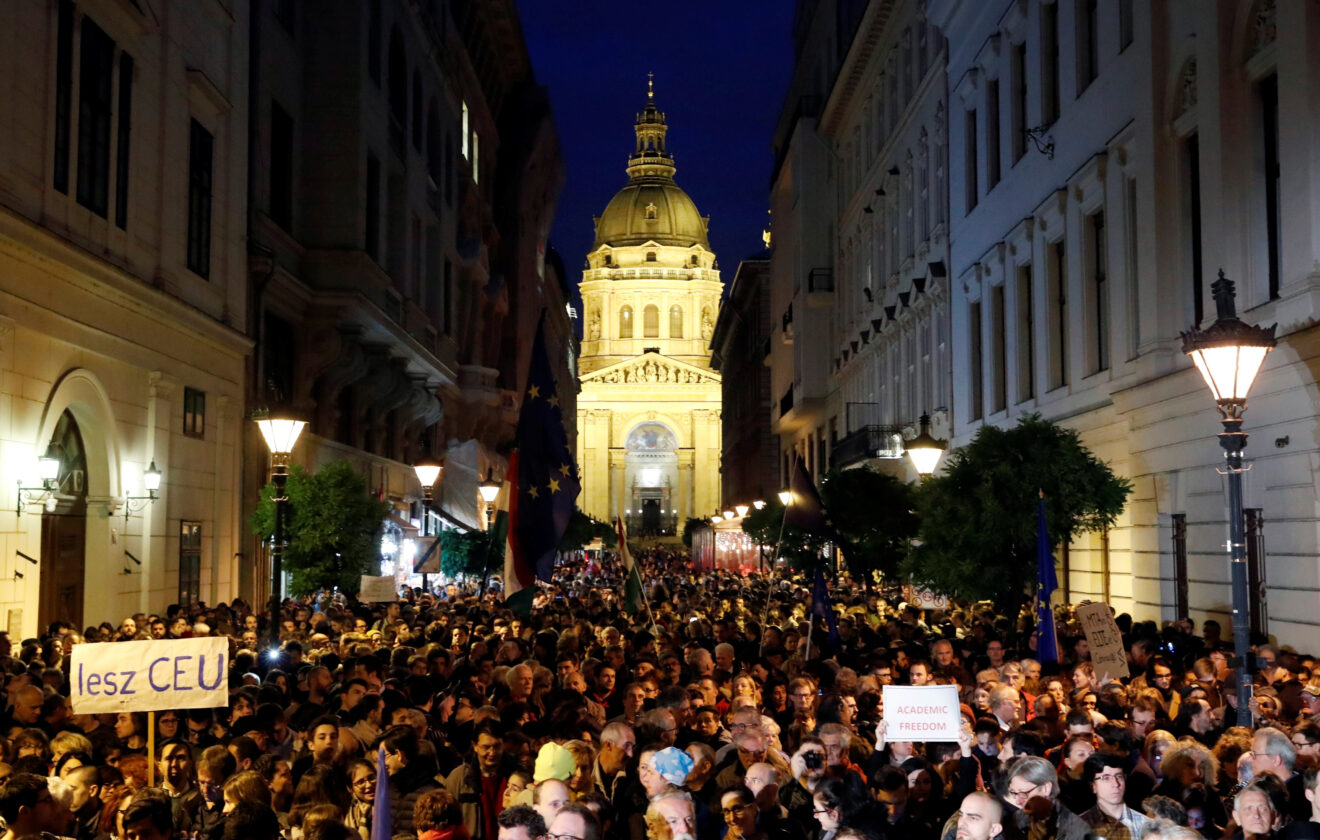
He recalled the large protests in Budapest in support of the university, when tens of thousands of people took to the streets. He described the moment as one of the most humbling of his life.
Schneider, a German political scientist who studies democracies and regime change, said Magyar had turned Orbán’s own political methods against him. He said the open question is whether Magyar also has the skills needed to rebuild a liberal democracy.
He said Hungary could become the world’s first “post-illiberal democracy,” a model for other countries. But he added that the real test will come when Magyar starts to lose support, given Hungary’s difficult economic situation.