Democrats control Congress after sweeping midterm wins, setting new limits on Trump
Voters angry about prices and the war with Iran handed Democrats both chambers and big wins in Republican strongholds. The last two years of Donald Trump’s term will look very different from the first two.

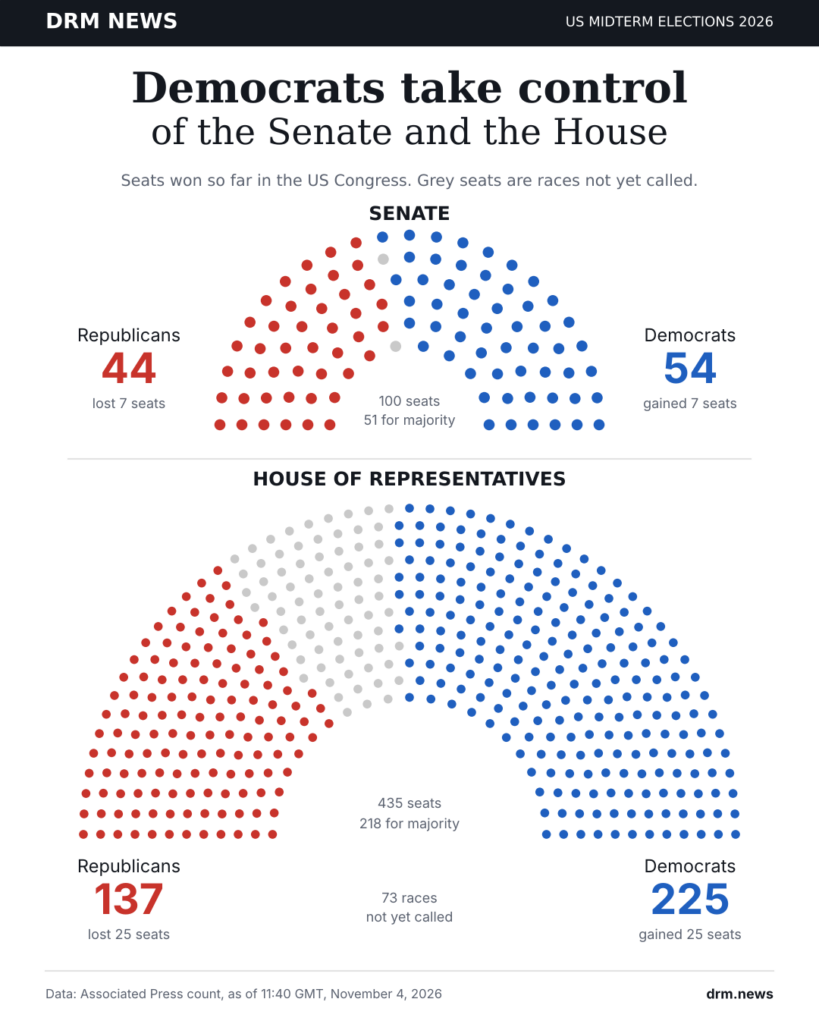
Democrats took control of Congress after Tuesday’s midterm elections, winning both the Senate and the House of Representatives in a sweeping rejection of President Donald Trump. Their victories came in parts of the country that have voted Republican for generations.
Voters who helped return Trump to the White House two years ago shifted sharply toward Democrats. Many cited anger over the war with Iran, concern about the rising cost of living, and dissatisfaction with the president’s leadership.
The result ends two years of Republican control of the White House and both chambers of Congress. When the new Congress is seated in January, Washington will return to divided government for the remainder of Trump’s term.
How the night unfolded
The Democratic wave showed up early. Shortly after polls closed in the East, Democrats began winning Senate races that had been viewed as long shots.
Before midnight, the Associated Press declared that Democrats would hold a majority in the Senate. The call came after Josh Turek’s victory in Iowa, a state Trump had won in all three of his presidential campaigns. Less than two hours later, Democrats also won the House, surpassing the majority by 218 seats.
Democrats flipped seven Senate seats previously held by Republicans, according to The Guardian. They also gained more than two dozen seats in the House and expanded their number of governorships. Senate races in Alaska and Mississippi remained uncalled early on Wednesday.
In the House, Democrats won all 20 of the most competitive races by early Wednesday, according to Reuters. Their gains stretched across the Midwest, the South, and the Southwest, including states where Republicans had dominated recent elections.
The results marked one of the party’s strongest midterm performances in decades. Democrats benefited from voter frustration over rising prices, the war with Iran, and the president’s handling of the economy. Exit polls found that many voters saw the election as a chance to send a message of disapproval to Trump.
For Republicans, the losses raise difficult questions about the party’s direction heading into the 2028 presidential race. For Democrats, the sweeping gains give them control of both chambers of Congress and a stronger platform to challenge the administration’s agenda when the new Congress takes office in January.
Senate seats that changed hands
The table below shows the Senate races in which Democrats won seats previously held by Republicans, based on Associated Press and projections from major networks.
| State | Democratic winner | Defeated Republican |
|---|---|---|
| Texas | James Talarico | Ken Paxton |
| Kansas | Adam Hamilton | Senator Roger Marshall |
| Iowa | Josh Turek | Representative Ashley Hinson |
| North Carolina | Roy Cooper | Michael Whatley |
| South Carolina | Annie Andrews | Senator Darline Graham |
| Ohio | Sherrod Brown | Senator Jon Husted |
| Maine | Troy Jackson | Senator Susan Collins |
Democrats also held on to seats in Georgia, Michigan and New Hampshire. Republicans kept seats in Florida and Montana.
Republican strongholds fall
Some of the biggest shocks came in states that Republicans have long counted on.
In Texas, the largest Republican state, Democrats ended a losing streak in statewide races that went back to 1994. James Talarico won the Senate race, and Gina Hinojosa ousted three-term Governor Greg Abbott.
Kansas elected its first Democratic senator in 94 years. In South Carolina, a state Trump won by nearly 18 points in 2024, Democrat Annie Andrews beat Darline Graham, the candidate Trump chose after her brother, Senator Lindsey Graham, died earlier this year.
In Maine, Susan Collins lost the seat she had held since 1997. She had stressed her willingness to break with the president, but it was not enough.
In Michigan, progressive Democrat Abdul El-Sayed won an open seat and became the first Muslim elected to the Senate. He beat Mike Rogers, a former congressman backed by Trump, who had sought to portray El-Sayed as a religious extremist, an attack Reuters described as false.
“You chose hate, and Michigan chose hope,” El-Sayed told supporters, speaking about Rogers.
Where the shift happened
The swing toward Democrats reached almost every part of the country.
Republicans lost ground in all but a handful of about 1,700 counties where most votes had been counted on Tuesday night, according to tallies compiled by Reuters and USA Today.
Democrats made gains in both the wealthiest and the poorest states. They gained where many people have college degrees and where few do. Their gains were especially sharp in counties with large Latino populations, including counties along the Texas border that had moved toward Trump in 2024.
The shift also showed up in farm country. In Seward County, Kansas, home to one of the country’s largest beef plants and where about half of eligible voters are Hispanic, Adam Hamilton led Roger Marshall by 13 points. Two years ago, Trump won the county by 39 points.
Republicans had also tried to gain an advantage by redrawing several House districts, an unusual move in the middle of the decade. However, the effort largely failed. Democrats held on to most of the targeted seats, including three districts in Florida.
What voters said
Exit polls showed deep frustration with the direction of the country.
Half of voters nationwide said they saw the midterm elections as a chance to rebuke the president, according to exit polls conducted by SSRS for a group of media outlets that includes major television networks and the Associated Press.
Three in four voters said they were angry or dissatisfied with the way things are going in the country. And 70 percent said they want Congress to act as a stronger check on the president.
Democrats ran on corruption and affordability. They blamed Trump’s tariffs and the war with Iran for pushing up prices, and they pointed to the billions of dollars the Trump family has earned since he returned to the White House.
Republicans, led by Trump, focused on cultural issues such as transgender rights and described their opponents as radical. But polls showed voters cared far more about prices.
Pre-election polls had shown Democrats ahead in many races, but the results went beyond what most surveys predicted. In Kansas, for example, polls showed Hamilton with only a small lead.
Trump’s reaction
Trump had told his supporters for weeks to vote as if he were on the ballot, and he held dozens of rallies in the final stretch.
On Tuesday night, as the losses mounted, he changed his message. “I wasn’t on the Ballot,” Trump wrote on social media, adding that if he had been, Republicans would have won in a landslide. He told The New York Times that because he was not on the ticket, Republicans could not get enough people out to vote.
Democrats had worried that Trump might try to overturn the results, as he did after the 2020 election. Instead, he accepted the outcome. He congratulated Democrats in an interview with Fox News and told The New York Times he was absolutely willing to accept the results.
He said he would work with Democrats on issues such as immigration. But he also threatened to veto bills he considered extreme.
In media interviews, Trump acknowledged that the war with Iran played a part in his party’s losses. But he stood by his decision to go to war.
Many of Trump’s chosen candidates lost. He backed Paxton over Senator John Cornyn in the Texas primary, picked Darline Graham in South Carolina and chose Michael Whatley in North Carolina. All three were defeated.
What a Democratic House can do
With a majority in the House, Democrats will be able to stop Republicans from passing bills through the chamber without their support. Hakeem Jeffries, the Democratic leader, is expected to become Speaker of the House.
The new majority will also gain the power to launch investigations. House committees can demand documents and call senior officials to testify under oath. They can also issue subpoenas and hold people in contempt if they refuse to cooperate.
Democrats have already set out some of their top targets.
Robert Garcia, the top Democrat on the House Oversight Committee, has said Trump family business dealings are first on his list. Representative Jamie Raskin has asked for information about the business dealings of Trump’s son-in-law, Jared Kushner, and his son, Donald Trump Jr.
Representative Jason Crow of Colorado, a member of the House Armed Services and Intelligence Committees, said he would begin with the Pentagon. He cited reports that defense funds had been directed toward companies linked to the Trump family.
The release of files linked to the late financier Jeffrey Epstein is also likely to stay in the spotlight. A push by Representatives Ro Khanna, a Democrat, and Thomas Massie, a Republican, forced the Justice Department to release millions of pages of files last year.
But the department missed its legal deadline and released about 3.5 million of the 6 million pages it holds, saying the rest were duplicates. Members of both parties have objected to heavy redactions in some files and to the apparent accidental release of victims’ names in others.
The Oversight Committee has been one of the few places in Congress where members of both parties have often worked together on the Epstein files. That is expected to continue.
The question of impeachment
Some Democratic voters are likely to pressure the new majority to impeach Trump for a third time.
House Democratic leader Hakeem Jeffries has said Democrats have not ruled anything out. The current Republican majority leader, Steve Scalise, has predicted that Democrats will try to impeach Trump on “Day 1.”
Impeaching a president requires only a simple majority in the House. However, removing a president from office requires a two-thirds vote in the Senate, which Democrats will not have. Even with control of both chambers, Democrats would need substantial Republican support to secure a conviction.
That means any impeachment effort would likely be more symbolic than practical, unless evidence emerged that persuaded a large number of Republican senators to break with the president. Still, House committees could use their investigative powers to examine the administration’s policies, spending, and potential conflicts of interest.
Democrats may instead focus on oversight, legislation, and blocking or slowing Trump’s nominees. Those tools could allow them to challenge the administration without needing the two-thirds Senate majority approval required for the office.
What a Democratic Senate can do
The Senate has the power to confirm a wide range of officials, including Cabinet members, ambassadors, federal judges, and any nominee to the Supreme Court.
With a majority, Democrats can block or slow many of Trump’s nominees, giving them leverage to push the White House toward compromise on legislation. They can also shape the agenda by deciding which bills reach the floor, controlling committee investigations, and influencing federal spending.
That power could prove especially important as Democrats seek to address rising prices, protect health care programs, and challenge administration policies on tariffs, immigration, and the war with Iran. While Democrats may not be able to pass major legislation without some Republican support, their control of the Senate makes it harder for Trump to govern without negotiation.
Senate Democratic leader Chuck Schumer said the results represented a major shift in the Senate map.
“Americans voted for change, and now Democrats must deliver,” Schumer said.
He added that Democrats would focus on lowering costs, protecting Social Security and Medicare, and restoring trust in government. Republicans, meanwhile, are expected to resist Democratic priorities and defend Trump’s agenda, setting up a period of intense negotiation and political conflict in Washington.
Lessons from 2018
This is not the first time Democrats have won a chamber of Congress halfway through a Trump presidency.
In 2018, during Trump’s first term, Democrats won the House in a wave election. House committees quickly opened dozens of inquiries into his businesses, the Russia investigations, and possible conflicts of interest.
A little over a year later, the House voted, mostly along party lines, to impeach Trump. Democrats accused him of pressuring Ukraine to investigate Joe Biden and then obstructing congressional oversight. The Republican-led Senate acquitted him on both charges.
In 2021, the House impeached Trump a second time, charging him with inciting the January 6 attack on the Capitol. He was acquitted again.
This time, Democrats will hold both chambers, giving them more tools than they had in 2019. With control of the House and Senate, they can shape legislation, control committee investigations, subpoena witnesses and documents, and influence federal spending and oversight.
Democrats are expected to focus on the cost of living, health care, government spending, and the administration’s handling of the war with Iran. They may also examine Trump’s policies on tariffs, Medicaid cuts, and the use of executive power.
For Trump, a Democratic Congress will make it harder to pass major legislation without compromise. It will also increase scrutiny of his administration at a time when his approval ratings have fallen, and attention is already turning toward the 2028 presidential race.
Firsts on election night
The night brought several historic firsts for both parties.
In Georgia, Democrat Keisha Lance Bottoms became the first Black woman elected governor of a U.S. state. In Florida, Republican Byron Donalds won the governor’s race and became the state’s first Black governor.
Democrat Gina Hinojosa will be the first Latina governor of Texas. In California, Democrat Xavier Becerra will be the state’s first Latino governor since 1875.
Looking toward 2028, the results could reshape the political landscape for both parties. The victories of candidates from diverse backgrounds may influence which leaders emerge as presidential contenders, while the gains in traditionally Republican-leaning states could encourage Democrats to compete more aggressively in the Midwest and the South.
For Republicans, the losses raise questions about the party’s message on the economy, health care, and the cost of living—issues that dominated many campaigns. For Democrats, the night offers momentum and a broader pool of potential national candidates as attention shifts to the next presidential election.
Looking toward 2028
The Constitution bars Trump from running for a third term. For most of the past decade, he has maintained a firm hold on his party, shaping its message, candidates, and policy priorities.
The new balance of power may accelerate his transition into a lame-duck president. With Democrats gaining ground in Congress, Trump could face greater resistance to his legislative agenda, investigations, and appointments. Attention is already turning to the 2028 presidential race, and potential successors in both parties are beginning to compete for influence, donors, and media attention.
For Republicans, the results raise questions about how much the party should continue to center itself around Trump, especially in states where his endorsement no longer guaranteed victory. For Democrats, the wins offer a chance to define the party’s direction ahead of the next presidential election.
The new Congress will be sworn in on January 3.