Ammar Ali Jan and the Fight for a Socialist Future
In an interview with DRM News, the Pakistani organiser makes a case for economic change while his answers on China and Ukraine expose difficult questions about power.
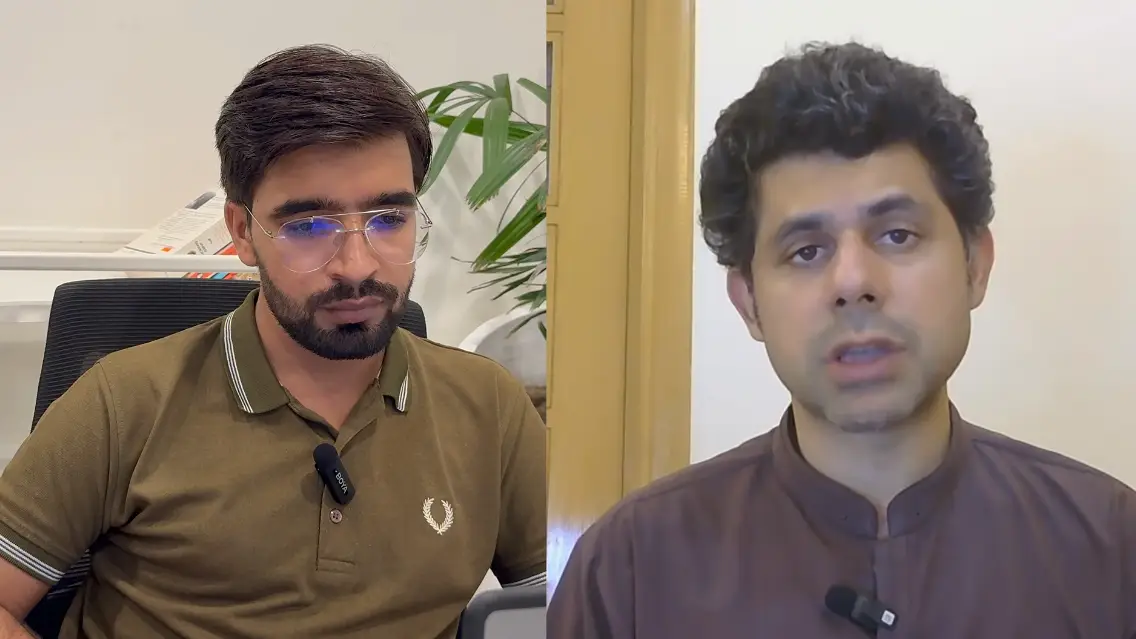
Ammar Ali Jan sees an opening for socialism in a country where it was long treated as a political liability: the United States. In Pakistan, he is still trying to turn the same ideas into votes.
When I asked him about Zohran Mamdani’s rise, Hasan Piker’s popularity and the alarm they were provoking among establishment Democrats, he saw evidence of a political system losing younger people’s trust. “The resonance of socialism will continue to rise in the US,” he said. The growth of Democratic Socialists of America provides an organisational backdrop to that optimism, while disputes over Piker’s influence expose a struggle within the Democratic Party over how far left it should move.
For Jan, the appeal begins with everyday insecurity. Younger Americans had watched enormous wealth accumulate, he argued, while finding it difficult to afford homes, secure jobs or complete their education. Israeli genocide in Gaza and the repression of campus protests had deepened their alienation. He compared the choices permitted by mainstream American politics to a debate between “Pepsi and Coca-Cola”: vigorous disagreement within a narrow range of options.
There is evidence for the generational opening he describes, though it needs precise wording. Gallup’s September 2026 release reported that 57 percent of Americans aged 18 to 34 viewed socialism positively, compared with 43 percent for capitalism. DSA, meanwhile, reported reaching 120,000 members in July. Mamdani’s arrival in New York’s City Hall gave democratic socialism a prominent governing platform.
Jan placed these developments within a wider argument about socialism’s international prospects. He defended the Soviet Union’s industrial achievements, saw China as a model of state-directed development and argued that the failures of contemporary capitalism were creating new opportunities for the left. But he resisted declaring victory. Even in the United States, he said, the left remained a marginal tendency. An opening would matter only if organisers developed a strategy to use it.
That was why I wanted to speak with him at this moment. As socialist ideas found an audience among younger people, I wanted to understand what they might offer a country where economic frustration has not translated into a comparable electoral breakthrough for the left. Jan, a relatively young figure in Pakistan’s politics and the author of Rule by Fear: Eight Theses on Authoritarianism in Pakistan, combines a critique of power with the practical task of trying to build it.
The historian and general secretary of the Haqooq-e-Khalq Party is also working within Tehreek Tahafuz Ayeen-i-Pakistan, or TTAP, the opposition alliance that includes former Pakistani PM Imran Khan’s Tehreek-e-Insaf (PTI). He presents cooperation with mainstream opposition forces as a way to defend constitutional politics and bring the left into a wider political conversation. It also creates a challenge: how to grow through an alliance without losing an independent identity.
His own electoral record shows the scale of the task. In the 2024 general election, contesting the Punjab Assembly seat PP-160 in Lahore, Pakistan’s second-largest city, Jan received 1,573 votes and finished fifth. That was approximately 2.35 percent of the constituency’s 66,872 valid votes.
“We don’t have a mass base as yet,” he acknowledged during our conversation.
Recorded for DRM Conversations on October 11, I tried to explore the distance between those two worlds: an international left finding new audiences, and a Pakistani left still trying to establish a durable popular constituency. Jan’s answer rested on sovereignty, socialism and democracy, alongside a willingness to work with private enterprise and mainstream political opponents.
As the discussion moved from Pakistan to China and Ukraine, another tension emerged. The demand that ordinary people control their lives was forceful at home. Abroad, his answers gave greater weight to the strategic interests of states confronting the West. For a politics that promises both economic security and freedom, the question is how consistently those commitments apply.
Jan described his childhood as relatively privileged. His parents were pro-democracy activists, and his father had been imprisoned under General Zia-ul-Haq. But he did not present his own political commitments as the product of personal deprivation. Inequality made a moral impression on him. Anti-war and immigrant-rights organising while studying in the United States helped give that impression a political form.
He remembered working alongside people whose nationalities and backgrounds differed from his own while studying in the United States. “We all shared a common humanity,” he said.
It is a useful starting point for understanding his appeal. His socialism promises that a person’s prospects should not be determined by wealth, nationality or proximity to power. His anti-imperialism promises that poorer countries should be able to make their own economic and political decisions.
But his immediate political problem is how to persuade people who have heard promises of transformation before.
“People don’t trust newcomers,” he said, adding that repeated betrayal gave them reason for their suspicion. His answer was sustained organising and alliances with social movements and mainstream opposition parties. He rejected the idea that the left could build power by remaining a small, ideologically exclusive faction.
When I asked why socialist politics had never gained mass appeal in Pakistan, he challenged the premise. He pointed to its influence on earlier political movements and cultural life. His explanation for the left’s subsequent weakness included its own choices: retreat from mainstream politics, internal preoccupation and what he called “purity politics”.
The candour is politically significant. Repression is part of his explanation, but it does not absolve the left of the need to organise better. His test will be whether alliances enlarge its independent base or leave it dependent on larger parties with different economic interests.
I asked him what an economy organised around his socialist principles would actually look like. His answer was less hostile to markets than the familiar caricature of socialism might suggest.
He explicitly rejected nationalising everything. Public ownership, regulation, private capital and markets could all have a place, he said. Planning would determine the direction: resources should meet human needs and support productive activity rather than enrich entrenched interests.
His central complaint was that Pakistan’s economy rewards those who control scarce assets and political access while failing to create sufficient opportunities for young people. He wanted resources redirected towards manufacturing, technology and industry.
That is an argument about the composition of investment and the power to direct it. It is also where the implementation questions begin. Who writes the plan? Who decides which firms deserve support? How does a government prevent politically connected businesses from capturing a new industrial policy?
Our conversation established his priorities more clearly than the institutions that would enforce them. These implementation questions remained open; he was not presented with each of them during the interview. Calling investment productive does not, by itself, protect public money from patronage. Nor does giving the state greater authority establish that workers will have greater authority over the state.
China was Jan’s most important example. “China is the future,” he said.
Its achievements cannot simply be dismissed. A 2022 study by the World Bank and Chinese government institutions estimated that close to 800 million people had moved above the then international extreme-poverty line of $1.90 a day over four decades.
But the explanation is more complicated than a victory for either pure planning or an unrestricted market. The same study emphasised economic transformation, education, outward orientation, public infrastructure, policies supporting competition and targeted poverty programmes. Its findings support taking China’s experience seriously without establishing that a single ideological label explains it.
Jan was on shakier ground when he said China had prevented finance and land from being used for speculation.
An IMF analysis published in 2024 described home prices stretched relative to incomes, developers borrowing on expectations of rising property values, and local governments dependent on land-sale revenue. The existence of state control had plainly not prevented speculative pressures or the accumulation of property-sector risk.
This does not erase China’s development gains. It does undermine an idealised contrast in which Chinese planning reliably defeats the distortions Jan identifies elsewhere. The more useful question for Pakistan is which institutions produced particular results, and which vulnerabilities they failed to contain.
The limits of his defence became sharper when I asked about Uyghurs and other predominantly Muslim communities in Xinjiang, and why criticism of China seemed less prominent in the left’s politics than criticism of the United States.
Jan objected first to comparing China with the United States. The scale and reach of American violence, he argued, required political judgment about which threat was primary. His historical analogy was resistance to British colonialism: opposing a foreign conqueror did not require believing that the ruler under attack was democratic.
He did not claim China was faultless. He acknowledged problems in Xinjiang and said he had criticisms of its response to militancy. But he devoted considerably more attention to what he considered Western propaganda and hypocrisy.
The imbalance left a substantive question unresolved. Governments can exploit an allegation for strategic purposes without making the underlying allegation false. The motives of Washington and the evidence about detention in Xinjiang require separate examination.
The UN human rights office’s 2022 assessment concluded that arbitrary and discriminatory detention of Uyghurs and other predominantly Muslim groups may amount to international crimes, particularly crimes against humanity. It also found allegations of patterns of torture or ill-treatment credible. This was an assessment by the UN human rights office, not a judgment by an international criminal court.
China rejected the assessment, arguing that it relied on fabricated information and misrepresented its counterterrorism policies.
Jan’s response included two claims that need particular scrutiny.
He suggested that improving life expectancy disproved allegations of genocide. But a long-term regional average cannot resolve whether particular groups were subjected to particular abuses during a shorter period. The Genocide Convention concerns prohibited acts committed with the specific intent to destroy a protected group, in whole or in part. Those acts include measures intended to prevent births and forcibly transferring children. Declining life expectancy is not a legal prerequisite. None of this, on its own, establishes genocide in Xinjiang; it explains why Jan’s proposed test cannot exclude it.
He also said that the Canadian government had called events in Xinjiang genocide and then withdrawn that position because of subsequent evidence.
The official records reviewed for this article do not substantiate that account. Canada’s House of Commons adopted a genocide motion in February 2021, with the federal cabinet abstaining. A further motion agreed in February 2023 explicitly reaffirmed the earlier recognition. Parliament’s position and the executive government’s position were distinct; cabinet abstention was not a later evidentiary retraction.
The larger problem is the threshold his argument appears to set. The UN assessment’s warning about possible crimes against humanity remains consequential whether or not the separate, more specific legal definition of genocide is met. Development statistics cannot answer a detention allegation, and Western hypocrisy cannot determine whether a survivor’s account is true.
Ukraine posed a related test of his commitment to sovereignty.
Jan advocated negotiations and said a settlement should respect both Ukrainian and Russian sovereignty. But he framed the war principally through NATO and American power. I pressed him on how Ukrainian sovereignty could be protected when Russia had invaded and was demanding Ukrainian territory. His answer returned to the global architecture of US military influence.
“Whether Ukraine loses a few kilometres here and there or Russia loses, that’s not world historical,” he said. “That’s not the main question.”
For the people whose homes and political future are at stake, territorial control cannot be reduced to a detail in a larger contest. In March 2022, the UN General Assembly demanded that Russia withdraw its military forces from Ukraine within its internationally recognised borders. That was a collective statement about sovereignty, not merely a demand from NATO.
Criticism of NATO policy does not remove Russia’s responsibility for its decision to invade. Nor does recognising Russian security concerns establish a right to determine Ukraine’s borders or political choices.
Jan acknowledged that the end of American dominance would not automatically bring freedom and that other states could act aggressively. His argument is therefore more qualified than an uncritical endorsement of every US adversary. Yet the priority he gives to weakening Washington can leave the agency of people caught between powers in the background.
Elsewhere in the conversation, that agency was central. He defended Kashmiri self-determination. He described democracy as the empowerment of people on society’s margins. On Palestine, he called for mobilisation, boycotts and sanctions to increase the costs of Israeli policy.
The challenge is to apply that attention to people’s choices consistently, including where it complicates an argument about the balance of global power.
The American opening brings Jan back to his task in Pakistan. Discontent creates an audience. It does not specify a programme, build an organisation or establish trust.
He knows that. His admission about lacking a mass base is more revealing than any prediction of an inevitable socialist return. It acknowledges that the future he imagines still has to be organised, argued for and chosen.
The strongest version of his project would give workers more economic security and greater power over the institutions that govern them. Its credibility will depend on whether those freedoms remain equally important when the government restricting them opposes the United States.
To assess that promise, I return to the common humanity he said first drew him towards politics. It is a demanding principle. It includes the people whose oppression strengthens his argument, and those whose experience makes it harder.