France protests return with nationwide strike, testing Macron months before election
Students, teachers, rail staff and hospital workers joined marches in about 260 towns and cities. About 70,000 police were deployed after riots last month caught authorities off guard.
PARIS, Nov 5 – France protests returned to the streets on Thursday, as flag-waving marchers filled cities and public workers went on strike in a fresh challenge to President Emmanuel Macron after weeks of unrest.
Trade unions, led by the left-wing CGT, called the nationwide strike, and student groups backed it. Hospital workers, air traffic controllers, postal workers, teachers and rail staff were expected to take part.
It comes five months before a presidential election. Macron cannot run again, and his last months in office have been marked by one crisis after another at home.
“We need to turn up in big numbers on the streets today,” CGT leader Sophie Binet told the television channel LCI. She said protests were planned in 260 towns and cities across the country.
Marches began in mid-morning in the southern cities of Marseille and Lyon, as well as in the western city of Nantes. The main march in Paris was set to begin at Place de la République at 2 p.m. local time.
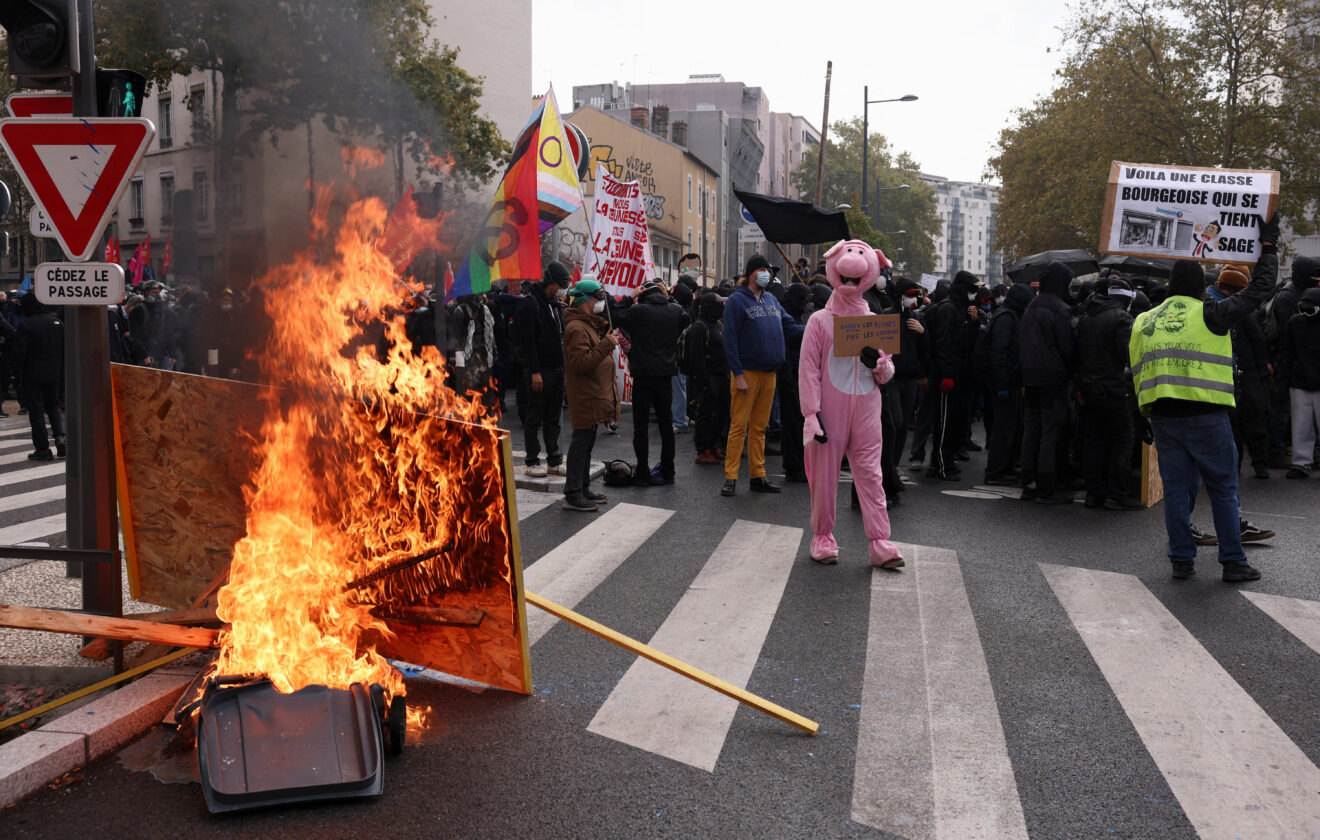
In Paris, high school students and other protesters clashed with riot police on Thursday morning after blocking a street with rubbish bins.
In Lyon, one banner called on high school students, pensioners, university students and workers to stand together. Some people there wore face masks or safety glasses to protect themselves in case police used tear gas.
Authorities are deploying around 70,000 police officers across the country. The domestic intelligence service expects between 500,000 and 700,000 people to join marches outside Paris.
The movement began with high school students angry about poor conditions in their schools. They have blocked schools in protest over crowded classrooms and run-down buildings.
They say the government’s response, a plan to cap some class sizes and lend money to regional authorities to repair schools, does not go far enough. University students have also blocked some faculties.
Workers then joined the students in weekly protests over the rising cost of living. The demonstrations grew into the worst civil unrest France has seen in years.
On October 17, riots and looting caught security forces off guard. Shops and public buildings were damaged across the country, and Macron faced sharp criticism over how he handled the crisis.
Unions called Thursday’s strike after a meeting with the government in October left them disappointed, according to Euronews.
The government is also fighting to pass a budget full of spending cuts through a divided parliament. France’s public debt is nearing 120 percent of its annual economic output.
Ahead of the strike, France’s four main rail unions said the planned cuts would deepen poverty, reduce social security, freeze public-sector wages, and drain funding needed for environmental projects.
The strike had an immediate effect, reducing France’s nuclear power output on Thursday morning. However, no major problems were reported on the transport network.
The national rail company SNCF warned of disruptions on regional lines and in parts of the greater Paris area. Dock workers said French ports would also face disruptions.
The Education Ministry said it expected about 17.5 percent of public primary school teachers to strike. Unions said secondary school teachers and teachers at private schools would also take part.
Rights groups have criticized the heavy police presence. The French Human Rights League said the government was making an “authoritarian shift” to silence dissent.
Authorities in several cities, including Rennes, Toulouse, and Lyon, have moved marches out of city centers. Some areas have also been placed under curfews. Binet said the government was showing a dangerous authoritarian drift.
Some students said fear was keeping people away.
“A lot of people are afraid of police violence,” said Irma de Banville, a 19-year-old student in Paris. The government has defended its police tactics and said any abuses would be investigated.
Macron held a defense and security meeting on Wednesday ahead of the protests. An official close to the president said the aim in the coming weeks was to “get the river that overflowed back into its bed.” The official said the government wanted the presidential campaign to begin in the calmest possible conditions.
The official noted that fewer high schools had been blocked this week than earlier in the crisis.
Nationwide protests last Saturday were mostly peaceful, though there were some clashes on the edges.
The unrest is feeding into the race to succeed Macron. Opposition parties are trying to capitalize on public anger over living standards and government policy. Marine Le Pen’s far-right National Rally is polling strongly ahead of the election, due next spring.