Britain And EU Agree Reset Deal On Food And Youth Mobility
Britain and the European Union have agreed deals on food trade, carbon pricing and youth mobility. Talks on university fees for European students will go on for up to six months.
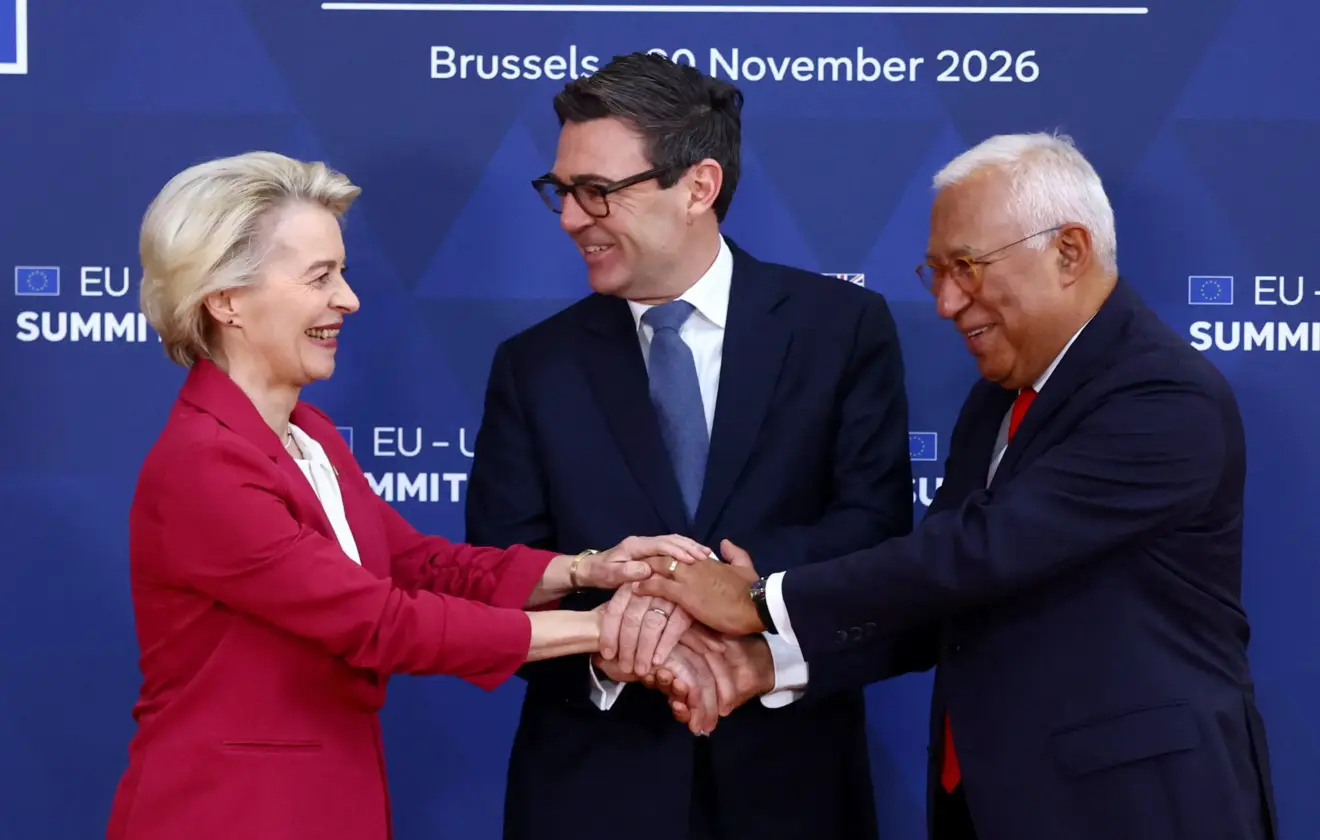
BRUSSELS, Nov 20 – Britain and the European Union agreed on a reset deal Friday covering food trade, emissions trading, and a new youth mobility scheme, Prime Minister Andy Burnham’s office said, though a dispute over university tuition fees for European students remains unresolved.
“The deal is done,” a Downing Street spokesperson said. The spokesperson said negotiations had concluded, less than an hour after Burnham arrived at the summit in Brussels.
Ursula von der Leyen, President of the European Commission, and Antonio Costa, President of the European Council, greeted Burnham. A string quintet played as he arrived.
Downing Street said both sides would now work to put the youth mobility scheme, the food trade deal and the emissions trading deal into effect. It said dates for each had been agreed and would be set out in a joint statement.
It said each side would now go through its own legal process to approve the deals. Talks will continue in some areas, it added.
The summit marks the biggest step yet to repair ties a decade after Britain voted to leave the bloc. Both sides have come to see the need for a closer alliance in a world shaken by Russia’s invasion of Ukraine, American tariffs, China’s grip on critical minerals and the war in Iran.
“In a more dangerous world, we are stronger together,” Burnham said in a statement before the summit.
He said Britain and Europe share values, interests and a neighborhood. He said the deals would help cut costs, keep prices down and give young people new chances.
The most important agreement covers food. It will allow trade in animals, plants and related products, such as sausages or seeds, across the border without the certificates and checks now required.
Britain estimates the deal could add up to 5.1 billion pounds, or about $6.7 billion, to its economy a year. It will only take effect from March 2028.
A second deal will link the emissions trading systems of Britain and the bloc. That will exempt goods from each side, such as steel, from the other’s carbon charges at the border.
Under the third deal, each side will let the other’s young people work or study for up to three years.
The number has been a point of debate. Britain, aware that immigration played a role in the Brexit vote, first proposed letting in 50,000 young Europeans. It has agreed to 100,000, according to European diplomats.
But the two sides still differ over tuition fees.
European Union countries want their students to pay the same lower “home” fees as British students at British universities, rather than the international rate, which is usually about four times higher. Britain prefers to offer only significantly reduced fees.
The aim is now to settle the issue within six months.
These three agreements were still being signed on Friday; however, their successful completion depends on how the fee issue is resolved, according to The Guardian. That sets a new political deadline for both sides.
Another sensitive issue is how far Britain will align with European rules, a touchy subject for opponents of rejoining the bloc.
Britain wants special status under the bloc’s “Made in Europe” rules, particularly for cars. The bloc has signaled that it is willing to grant this, but only if Britain aligns with its policies, including limits on imports of Chinese electric vehicles.
In the final joint statement, Britain agreed to ensure outcomes consistent with relevant European measures to protect industries and prevent rules from being circumvented.
That appears to refer to a plan backed by France and Germany. Under it, European public money could be spent on British cars, if Britain agreed to keep pace with the bloc’s trade protection measures. That could mean Britain adopting limits on Chinese-made hybrid and electric cars, which London has so far resisted.
Burnham brought a large team of ministers to Brussels, a sign of how seriously London is treating the summit.
They included Lou Haigh, the first secretary of state, Chancellor John Healey, Foreign Secretary Ed Miliband, Business Secretary Jonathan Reynolds, Environment Secretary Angela Eagle and Chief Whip Anneliese Midgley.
The summit had been planned for July but was delayed when Burnham’s predecessor, Keir Starmer, resigned.
Burnham has said Britain should consider all options for its future ties with the bloc, including rejoining. On Monday, he said it was the obvious truth that Britain had lost more than it gained from Brexit.
Britain left the bloc in 2020.