China’s Shenzhou-24 Takes Off With First Pakistani Astronaut On Board
China's latest crewed flight lifted off from Jiuquan on Wednesday with two Chinese astronauts and one Pakistani. Prime Minister Shehbaz Sharif called it a historic first.
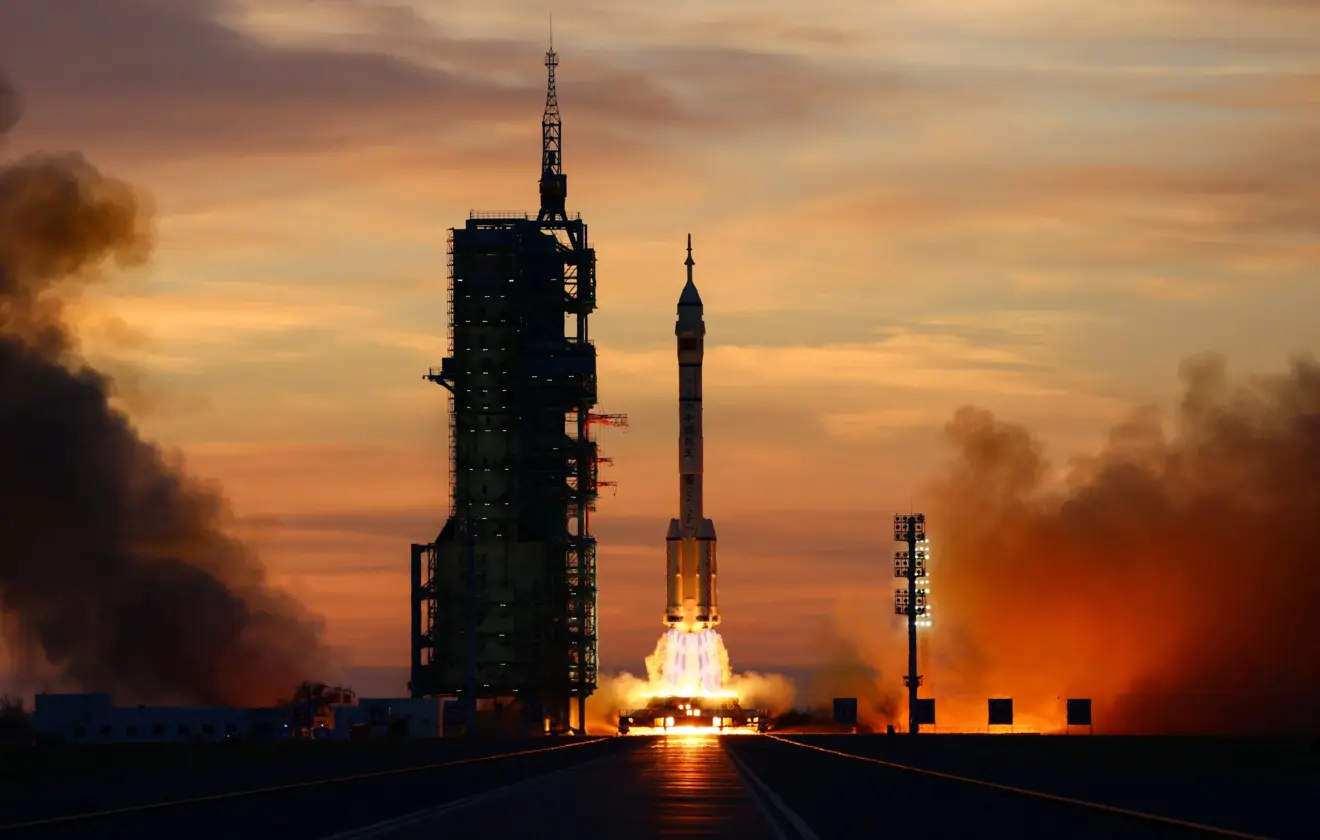
JIUQUAN, China, Nov 25 – China’s Shenzhou-24 spacecraft lifted off successfully on Wednesday with Zeeshan Ali on board, making him the first Pakistani in orbit.”
The Long March-2F rocket took off from the Jiuquan Satellite Launch Center in northwest China at 8:18 a.m. local time, or 5:18 a.m. in Pakistan.
On board Shenzhou-24, Ali, a 40-year-old pilot whose full name is Muhammad Zeeshan Ali, is flying with Chinese commander Tang Hongbo and flight engineer Wu Yi.
Minutes after launch, the three men could be seen leafing through a flight manual on a live feed from the state broadcaster China Central Television. The broadcaster said the crew was in good condition.
In Islamabad, Prime Minister Shehbaz Sharif called the flight a historic first. In a post on X on Tuesday, he thanked Chinese President Xi Jinping for the opportunity.
“Pakistan-China friendship is surpassing the heights of the Himalayas,” Sharif wrote, adding that the friendship was now on its way to outer space.
Ali will serve as a payload specialist at the station and conduct scientific research for a period of five to 10 days that is far shorter than the six-month rotation that Chinese astronauts usually serve, but analysts say the flight still matters a great deal for Pakistan.
Blaine Curcio, founder of the Hong Kong-based firm Orbital Gateway Consulting, said it would bring Pakistan prestige, scientific and technical knowledge, and deeper diplomatic goodwill with China.
Ali had spoken of the weight of the moment before he left.
“I’m not flying for myself. I carry the name of Pakistan on my shoulder,” he told reporters on Tuesday.
He spent seven months training in Beijing for the mission. Alongside the technical work, he took Chinese language classes, learned Chinese songs and read Chinese poetry. He also practiced calligraphy and played table tennis.
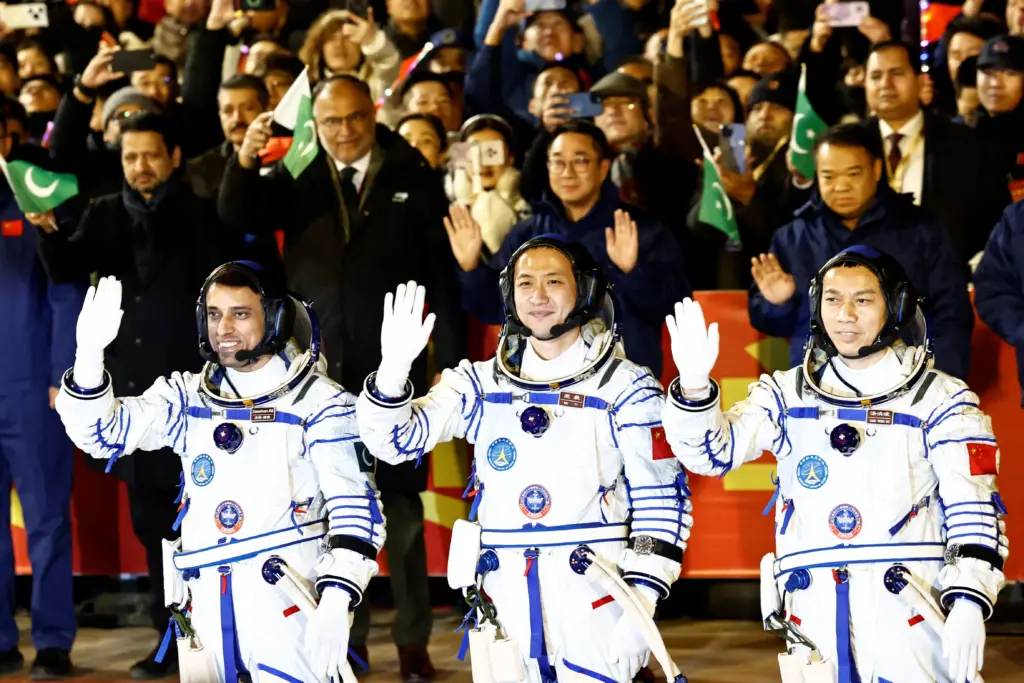
Chinese astronauts Tang Hongbo, Wu Yi and Pakistani astronaut Muhammad Zeeshan Ali wave near Ambassador of Pakistan to China, Syed Ali Asad Gillani, and Minister for Planning Development and Special Initiatives of Pakistan Ahsan Iqbal Chaudhary during a see-off ceremony before taking part in the Shenzhou-24 spaceflight mission to China’s Tiangong space station, at Jiuquan Satellite Launch Center, near Jiuquan, Gansu province, China, November 25, 2026. REUTERS
Space cooperation between the two countries goes back to the early 1990s. China has launched several Pakistani satellites, and a rover built in Pakistan is due to fly on a Chinese mission to the moon around 2028.
For Beijing, the flight is also a chance to show off Tiangong to the world.
China is promoting the station as a center for international cooperation in space. The International Space Station, led by the United States space agency, could be retired by 2030.
Tiangong, whose name means “Celestial Palace,” was built by China alone and has been fully operational since late 2022. It can host up to six astronauts during handovers, when an arriving crew of three overlaps with the crew that is leaving.
This handover will be unusual.
Zhu Yangzhu, commander of the Shenzhou-23 crew already on board, will stay on for a full year. China wants to study how the human body copes with long periods in space, which it sees as a key step toward sending astronauts to the moon and, later, to Mars.
The other members of the Shenzhou-23 crew will return to Earth with Ali. By the time Zhu leaves, he will hold the record for the longest single stay in orbit by a Chinese astronaut.
China still aims to land humans on the moon by 2030, despite the delay of its Chang’e-7 lunar mission later that year. The postponement was caused by severe weather from a tropical storm, which prevented the mission from meeting launch requirements.
The United States aims to return astronauts to the moon by 2028, and the two powers are competing to establish bases there. China plans to set up a lunar research station with Russia by 2035.
Washington has warned that Beijing could seek to control access to resource-rich parts of the moon. Beijing rejects that claim, saying it supports the peaceful use of space.
For now, Zeeshan Ali and his two Chinese crewmates are on their way to the station, where Zhu and the Shenzhou-23 crew are waiting.