Trump, Xi And Putin At One Table Show The Birth Of A Multipolar World Order
Critics call the Shenzhen summit a footnote. But three rivals with wars and proxies between them still sat down for their own gain, and that shows the age of one superpower is over.
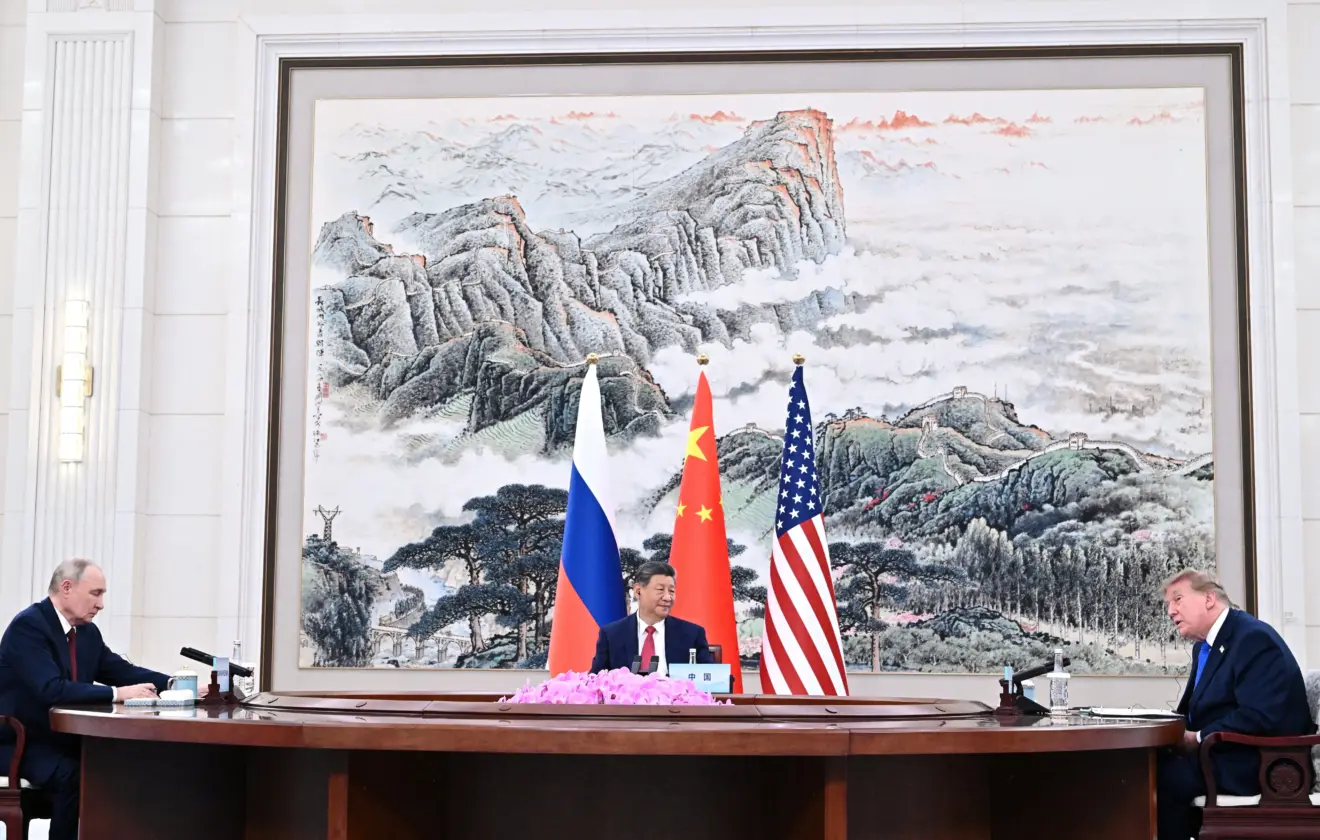
For the first time, the leaders of China, Russia and the United States sat at one table, a moment that signals the end of a world run by a single superpower.
Critics have dismissed the summit as a footnote. They point to its thin results: about 90 minutes of talks, a four-point declaration, no treaty, no date for arms talks and no plan to end a single war. Measured against the eight days of Yalta in 1945, they argue, Shenzhen was small.
That reading misses what actually happened at that lakeside villa. The summit was modest because the world it reflects is different. Power is now shared, and no single country, or even a group of three, can carve up the globe at a conference table. Instead, three rival centers of power sat down because each needed something from the others.
That is not a footnote. That is what a multipolar world order looks like.
Start with the history, because everyone else has.
In February 1945, Joseph Stalin, Winston Churchill and Franklin Roosevelt met at Yalta, a resort in Crimea, as the war against Hitler’s Germany neared its end. British and American troops had pushed through France and Belgium. The Soviet army was rolling across Eastern Europe. Germany’s defeat looked certain.
At Yalta, the three allies sketched out the postwar world. Stalin agreed to join the war against Japan in return for territory in the northern Pacific. Roosevelt, frail and only two months from his death, gave the Soviets wide room over Poland’s future. That opened the way to decades of Soviet control over Eastern Europe.
Churchill fought to stop Germany from being crushed under harsh terms, as Stalin wanted. He feared a repeat of the Treaty of Versailles, which many believe planted the seeds of the Second World War. And Roosevelt used the conference to push his plan for a new body that would settle disputes through talks rather than war. The United Nations was formally set up nine months later.
For much of Eastern Europe, Yalta became a byword for betrayal. Countries occupied by Soviet troops remained under Communist rule throughout the Cold War.
Even so, historians warn against reading too much into the conference itself. David Reynolds, a historian at the University of Cambridge, argues that Europe’s fate was “decided on the battlefield, not at the conference table.” A year before Yalta, in Moscow, Churchill and Stalin had already scribbled their secret “percentages” deal on a scrap of paper, splitting Europe between the Western and Communist camps.
A year before that, at Tehran in 1943, the mood was even grander. Churchill told his partners: “In our hands we have the future of mankind.” Stalin went further, saying history had “spoiled” them with great power and great opportunity.
No one in Shenzhen said anything like that. And that is exactly the point.
The men who met at Yalta were allies, or at least still allies on the surface, as the historian Catherine Grace Katz puts it: “Their goals overlapped”. They had a common enemy and almost won a war
The men who met in Shenzhen are rivals.
Two of them are still stuck in unresolved wars. Vladimir Putin is bogged down in Ukraine, where Russian forces hold about a fifth of the country. Donald Trump is tied up in a war with Iran. Days before the summit, a Ukrainian strike badly damaged the road section of the bridge linking Russia to occupied Crimea, the same peninsula where Yalta sits.
These three powers back opposite sides in real conflicts. They compete over chips, trade and Taiwan. And yet they sat around one table, Xi Jinping in the middle, Trump to his left, Putin to his right.
They did not sit down out of friendship. They sat down because each could leave with something.
Trump got to demonstrate how close he is to two leaders he openly admires. He described Putin not only as a friend but treated him almost like a wartime partner. Former British foreign secretary Jeremy Hunt said the scene showed that Trump was no longer the leader of the free world.
Putin got to show his people that it is Moscow, not Europe and certainly not Ukraine, that has the ear of Washington and Beijing. He waved away the meeting of Ukraine’s allies in Berlin as a sideshow. He said Europe’s effort to isolate Russia had failed and that the Asia-Pacific is now the center of the world economy. He even said his ties with Trump rest on “similar civilisational values.”
Xi got the biggest prize of all. He played host without saying so; he showed that the era of American dominance is over. In one neat summary of the summit, the United States is the consumer economy, China the manufacturing giant and Russia the energy bank. None of them can run the world alone. All three must share the stage.
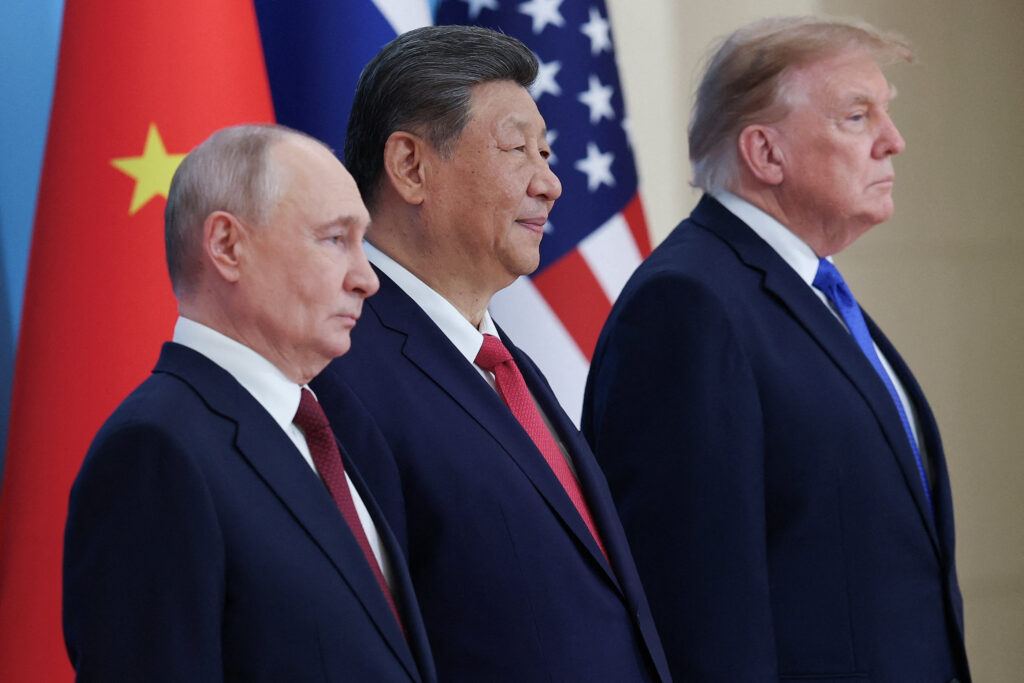
Russian President Vladimir Putin, Chinese President Xi Jinping and U.S. President Donald Trump arrive for a trilateral meeting at Kylin Villa on November 19, 2026 in Shenzhen, China.via REUTERS
Look closely at how Beijing staged the event, and the new balance becomes even clearer.
When Trump visited Beijing in May, he was met at the airport by China’s vice president, Han Zheng. In September, Trump went to Joint Base Andrews to greet Xi in person. In Shenzhen, Xi returned the favor. It was the first time in his presidency that he had greeted a visiting leader at the airport.
Japan’s prime minister, Sanae Takaichi, by contrast, arrived with no ceremony at all.
Putin was met on a red carpet by Cai Qi, Xi’s chief of staff and the fifth-ranking member of the Communist Party’s leadership. Some read that as a snub. But after the talks, Xi walked Putin to his car, shook his hand and stayed to watch him go. A Chinese saying advises a host to take three steps to welcome a guest and seven to see one off.
The message was carefully balanced. Beijing can embrace Washington without dropping Moscow. It can deal with both partners without being dragged into every one of their fights.
That is how power works in a multipolar world. Not in fixed blocs, but in shifting deals between centers of gravity.
The constant discussion on Nuclear
Washington wanted the summit to focus on nuclear arms control. It wanted all three countries at the table. Beijing has long said that the United States and Russia, with far bigger arsenals, should cut first.
In the end, the leaders agreed only to discuss nuclear risks and ways to stop the spread of nuclear weapons. They set no date. They agreed to no limits on warheads. They announced no treaty talks.
On paper, that looks weak. But it is also revealing. China, for the first time, now has a seat in a conversation long run by Washington and Moscow, while keeping full control over the size of its own arsenal. Fear of nuclear war is the one thing that forces these rivals to keep talking. It is the glue of the new order, even if it does not yet produce cuts.
Xi put his own case. When major powers are at peace, he said, “the world is secure.” When they clash, there is chaos.
This is where Shenzhen differs most from Yalta, and where the case for a multipolar order is strongest.
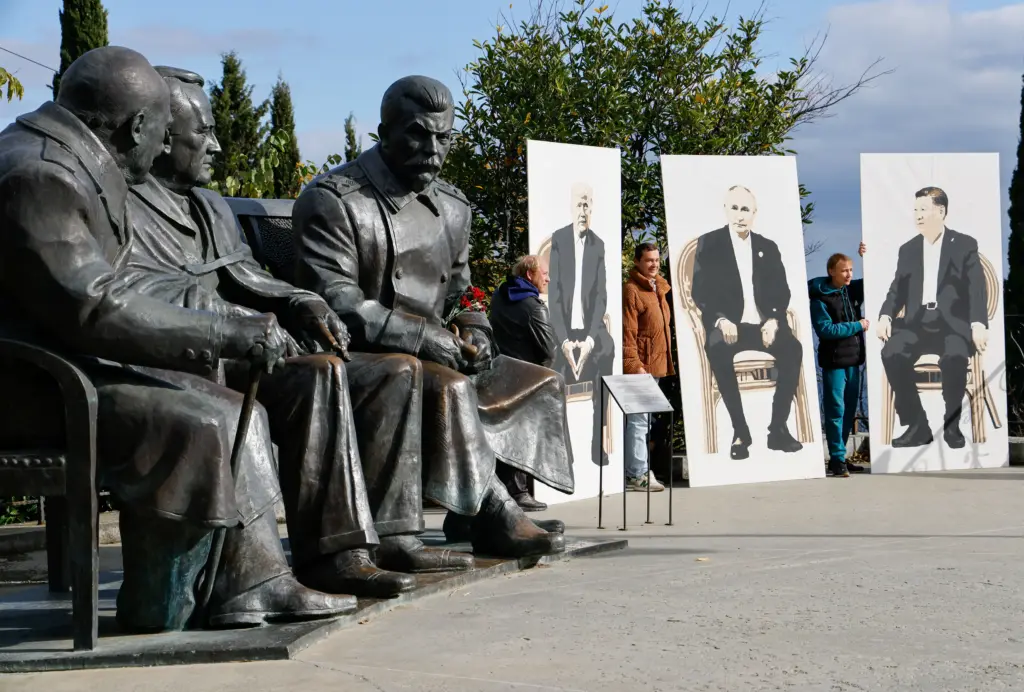
Members of the “Art Lift” collective place the artwork depicting November 16, 2026. REUTER
In 1945, the great powers could split the map and go their separate ways. Today, they cannot. The world they share is tied together by trade, supply chains, and technology in ways the leaders at Yalta never had to consider. Shenzhen took place at an uncertain time marked by wars, climate change, and the rise of artificial intelligence.
Xi and Putin used the summit to attack protectionism and sanctions. Access to advanced American chips remains a fight between Beijing and Washington alone. Each power is tied to the others through markets it cannot simply leave.
That is why the three leaders did not, and could not, divide the world into neat zones. Globalization has made that kind of carve-up impossible. What it has produced instead is a world of several powers, each strong in its own region, each tied to the others, each forced into talks it cannot avoid.
Even the critics hint at this. One of the sharpest reviews of the summit suggested that technology, multipolarity and the leaders’ own divisions may mean that even these three no longer hold “very great power.” That is not an argument against a multipolar world. It is a description of one.
None of this means the skeptics are wrong to raise questions. Their doubts deserve a fair hearing.
The declaration’s four points were thin. The leaders backed reform of the United Nations without saying how power in it should be shared. They promised more supplies of refined oil products without any target. Their clearest wording was on the International Criminal Court, stressing the immunity of state officials, which suits Putin, who faces an arrest warrant from that court over the war in Ukraine. The text said nothing about Ukraine and Iran. Trump said before the meeting he would not seek help from China or Russia to end the war with Iran.
Five days before the summit, the agenda was still not settled. Moscow wanted to raise Ukraine. Beijing reportedly resisted. And Europe pushed back hard. In Berlin, German Chancellor Friedrich Merz warned that a Yalta-style format could not bring peace.
Putin defended Yalta, saying it simply recognized the realities of its time, and that today’s conflicts must also come to terms with “realities on the ground.” Ukraine’s foreign minister, Andrii Sybiha, answered sharply. “Shenzhen is not the Yalta of Putin’s dreams,” he wrote, pointing to the damaged bridge to Crimea.
He is right about one thing. On Ukraine, there is a fourth voice. Without Kyiv, the other three can settle very little.
But that, too, proves the point. In a multipolar world, no club of great powers can impose its will. Smaller countries still have a say, especially on the battlefield. The order taking shape is not a new Yalta. It is messier, more crowded and more balanced.
Chinese Foreign Minister Wang Yi says officials from the three countries will stay in touch. The next test comes at the Group of 20 summit in Miami on December 14 and 15. Trump is expected to meet Xi there, and Putin says he will consider attending.
But the larger shift has already happened. The United States, China and Russia remain rivals, backing opposite sides in wars and competing for markets and technology. Yet they sat down together, because none of them can shape the world alone.
The new order will not be run by a single superpower or split into neat zones, as Yalta divided Europe. It will be managed, often uneasily, by several powers tied together by trade, technology and the fear of nuclear war.
The multipolar world China has long called for is no longer an idea. In Shenzhen, it became a reality.