Alberto Núñez Feijóo Pitches Himself As The Manager Spain Needs
Spain's conservative frontrunner Alberto Núñez Feijóo is running on his record as a manager, but polls suggest he would need far-right Vox to form a government.
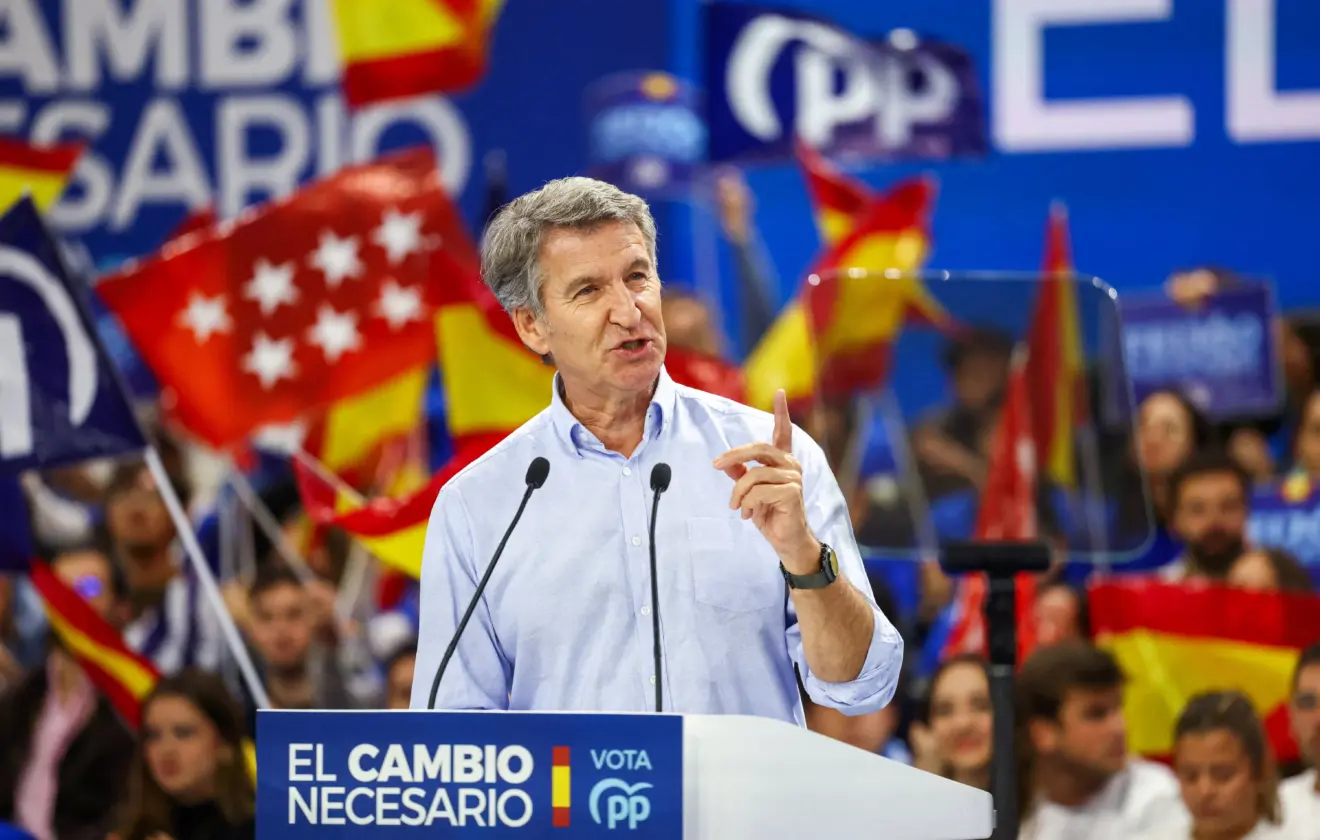
MADRID, Nov 27 – Alberto Núñez Feijóo, the conservative leader expected by most polls to become Spain’s next prime minister after Sunday’s election, is asking voters to judge him on his record as an administrator, after a campaign dominated by a deadly train crash and a migrant crisis.
His centre-right People’s Party (PP) leads the polls ahead of the vote. Most surveys suggest, however, that he would need the support of the far-right Vox party, led by Santiago Abascal, to secure a majority in parliament. That would make Vox the first far-right party to join a Spanish government since the death of dictator Francisco Franco in 1975.
“I come from a management background. It’s what I know how to do, it’s what I want to do, and it’s what Spain needs,” Alberto Núñez Feijóo, 65, told a rally this month.
The pitch is aimed at voters angry over how the government of Socialist Prime Minister Pedro Sánchez handled both crises. In a YouGov poll, 59% of Spaniards blamed the government or the state-owned rail infrastructure company Adif for the Oct. 28 train crash in central Spain that killed 69 people. A September survey by pollster 40dB found two-thirds of Spaniards rated Sánchez’s response to a mass migrant crossing into Ceuta in July as “bad” or “very bad”.
Alberto Núñez Feijóo built his reputation running large public bodies, including the National Health Institute (Insalud) and the postal company Correos. He went on to win four elections in a row as head of the regional government of Galicia, where he was born, and became PP leader in 2022.
He arrived in Madrid in 1996 to run Insalud. Rafael Matesanz, founder of the National Transplant Organisation and Insalud’s director general under Feijóo from 1996 to 2000, said his boss set targets for cutting waiting times and stuck to them.
According to Insalud’s annual report for 2000, the average wait for surgery fell by almost half over that period, to 67 days. The number of people waiting longer than six months dropped from 50,858 to 2,826. The total number of people on waiting lists fell by 24% in his first two years, but had nearly returned to its earlier level by the time he left.
Matesanz described him as structured and driven, a man who pushed his staff as hard as he pushed himself and often worked until 11 p.m., though he was slow to start in the morning and often late. “For me, those were probably the four most demanding years of my working life,” Matesanz said.
Alberto Núñez Feijóo has admitted to being a workaholic, telling reporters last year that “holidays are overrated.”
He grew up in Os Peares, a hamlet in northwestern Spain, living above a shop run by his grandmother. He had his only child at 55 with his partner Eva Cárdenas, the first director of Zara Home, the interiors business of the Spanish fashion group.
Lorenzo Bernaldo de Quirós, head of the consultancy Freemarket Corporate Intelligence, who has known him for 20 years, described Alberto Núñez Feijóo as a self-made man whose life shows that social mobility is possible. He called him a pragmatist rather than an ideologue, with a fixation on reducing Spain’s deficit and debt.
On immigration, Alberto Núñez Feijóo has promised to reverse the more open policies pursued under Sánchez. He says he would ban mass amnesties, tighten border controls, deport foreigners with criminal records and bring in a points system for legal migrants.
In private he is shy but has a good sense of humour, according to Bernaldo de Quirós. In public, Feijóo admits, he keeps jokes to a minimum. “Am I a serious person? Yes. Is that a flaw? It’s a sign of respect,” he said in a speech on Nov. 14.
He is also known for verbal slips. His campaign team has tried to turn that into a joke, posting a video of him laughing at AI-generated images of himself as a superhero called “Anotop At”. The name refers to a moment in parliament last year when he stumbled while trying to say that a film about Sánchez’s life should be titled “Anatomy of a Fraud”.
If Alberto Núñez Feijóo wins power, he will face comparison with Mariano Rajoy, the last PP prime minister and another Galician known for a technocratic style. Ignacio Peyró, director of the Cervantes Institute in Rome and Rajoy’s speechwriter from 2012 to 2017, noted that Rajoy won a comfortable majority in 2011, while Feijóo would probably have to share power.
Keeping Vox in line would be his biggest test, Peyró said. The two parties share some positions on immigration but disagree on keeping Spain’s system of regional self-government, on deeper EU integration and on free trade.
Like Rajoy when he first took office, Alberto Núñez Feijóo does not speak English, and told podcaster Jordi Wild that he had not “made any effort in this regard.” Bernaldo de Quirós said this could put him at a disadvantage in negotiations in Brussels.
Nic Lawley, special adviser to the chief executive of London think tank Chatham House, said it suggested Alberto Núñez Feijóo would be “more insular” than Sánchez, pulling back from the higher international profile Spain has had in recent years.
Feijóo himself has leaned into the contrast. “When it comes to good looks, they say Sánchez beats me,” he said in a video posted on X. “I am a hard worker. Good management will replace frivolity.”