Abu Dhabi Peace Talks Reunite Russia and Ukraine After 9 Months
Trump’s envoys say the gaps have narrowed. But Moscow still wants all of the Donbas, and Kyiv says it will not give up land.
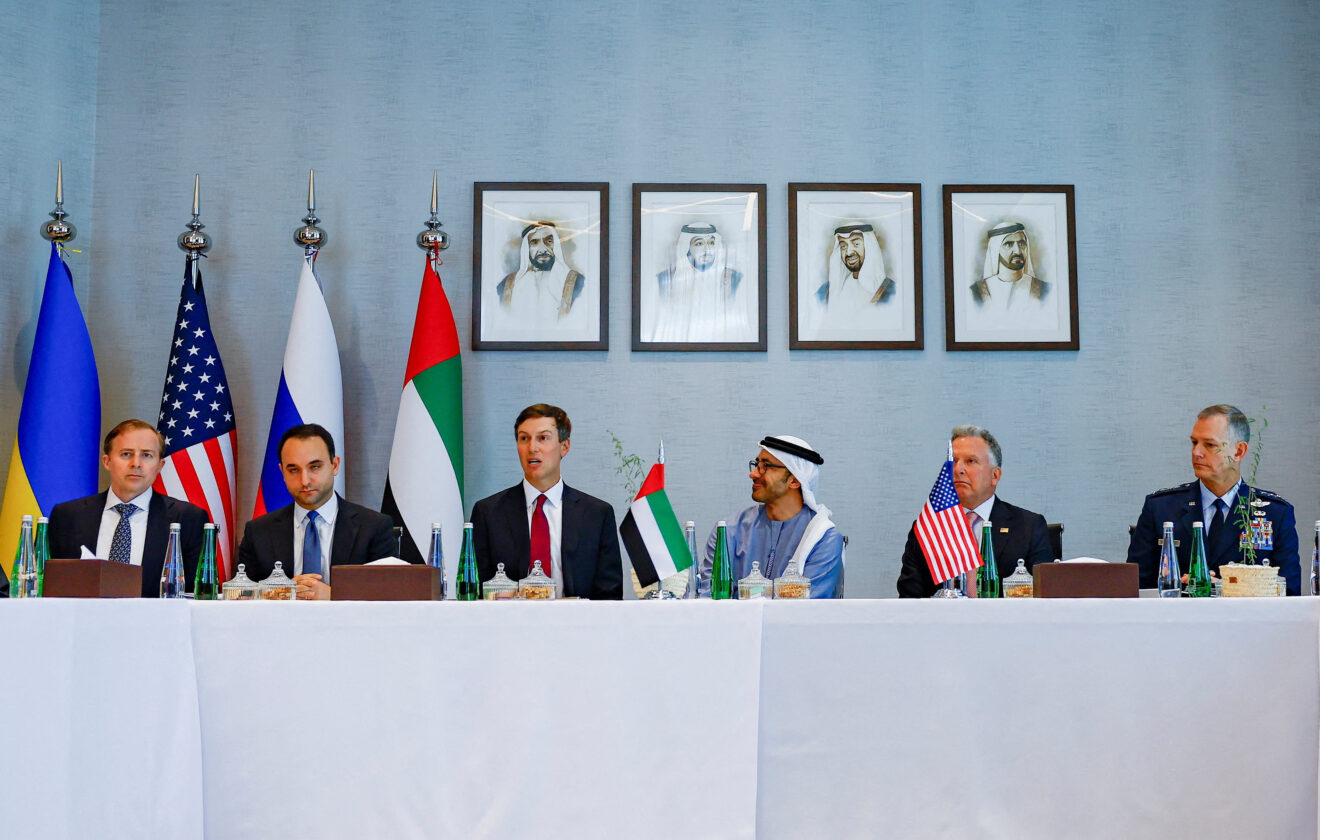
ABU DHABI, Nov 10 – Russian and Ukrainian officials sat down on Tuesday for Abu Dhabi peace talks brokered by the United States, their first such meeting in nine months. The talks come after President Donald Trump said last week that a wide deal to end the war could be within reach.
The talks are set to run over two days, on Tuesday and Wednesday.
Jared Kushner, Trump’s son-in-law, and special envoy Steve Witkoff are leading the United States side. Kushner told the delegates that recent contacts with both sides had helped close the gap between them.
“Really identified, narrowed the gaps,” Kushner said of those contacts.
He said the United States had several promising ideas for closing the remaining gaps. Trump had instructed his team to work intensively on an agreement that would end the war and leave both countries in a stronger position.
However, the two sides remain deeply divided. More than four and a half years after Russia launched its full-scale invasion, Russian forces continue to occupy roughly one-fifth of Ukraine.
Ukraine’s chief negotiator, Rustem Umerov, said in his opening remarks that Kyiv was seeking credible security guarantees and a durable peace.
Moscow, however, wants to approach the issue differently. Speaking in Moscow, Russian Foreign Minister Sergei Lavrov argued that the parties should first agree on a broader security framework for Europe before addressing the war itself. A source within the Russian delegation said Moscow views this as the central objective of the talks.
European leaders see the sequence differently. European Commission President Ursula von der Leyen said on Monday that broader security discussions should take place only after a ceasefire has been achieved. Lavrov again rejected a truce, accusing Europe of attempting to buy Ukraine more time.
Europe is also seeking a seat at the negotiating table. Before the main meeting began, Ukrainian officials held separate discussions with representatives from European governments, the European Union, and the North Atlantic Treaty Organization, alongside Kushner and Witkoff.
France said that a lasting peace could not be achieved without addressing Europe’s security and that European input was essential. But Russia has made clear that it does not see a role for European representatives in the meeting involving Ukraine and the United States.
The last round of three-way talks took place in February. They stalled when the war with Iran broke out, and Washington’s focus shifted. Talks have picked up again in recent weeks. Before Abu Dhabi, Witkoff and Kushner held long talks with Russian President Vladimir Putin in Moscow, and Trump met a Putin envoy at the White House last week.
On the eve of the talks, Trump said both sides were tired of fighting.
He said Washington saw a “very strong inclination” to bring the war to an end. Trump has repeatedly suggested that a peace deal was close, though no agreement has been reached so far.
The central obstacle remains territory. In public, Putin has shown no indication that he is prepared to abandon his demand that Ukraine cede the entire eastern Donbas region before any settlement. Ukrainian President Volodymyr Zelenskiy has firmly rejected the idea of surrendering territory that Ukrainian forces have fought and died to defend.
A senior U.S. official told Reuters that negotiators believe both leaders may be willing to make limited compromises. Under the framework being discussed, Ukraine would receive an end to the war, security guarantees, and a credible path toward European Union membership.
However, a senior Ukrainian official flatly denied that Kyiv would accept such territorial concessions. The official said that any discussion of land could take place only between the two leaders and would have to be accompanied by robust, enforceable security guarantees for Ukraine.
Zelenskiy argues that Ukraine’s negotiating position is improving. Ukrainian forces have recently recaptured some territory in Donetsk, a coal-mining region within the wider Donbas.
“Ukrainian forces are currently genuinely strengthening Ukraine’s negotiating position,” Zelenskiy said in his nightly address on Monday.
He also claimed that Russia was suffering record battlefield losses, a claim Moscow rejects. Zelenskiy urged Washington to increase pressure on the Kremlin to end the war.
On the battlefield, Russia’s advances have slowed considerably this year. Nevertheless, Moscow has continued to strike Ukrainian cities, energy infrastructure, and power plants. Ukraine, for its part, has intensified attacks on Russian oil refineries and other strategic facilities deep inside Russian territory.
The United Arab Emirates hosted the talks, where the country’s foreign minister, Sheikh Abdullah bin Zayed Al Nahyan, joined the American envoys at the opening session, underscoring the UAE’s role as a key mediator in the negotiations.