TAPI Pipeline Set To Reach Afghan City Of Herat By Year End
Turkmenistan has laid most of the 153-kilometer leg to Herat and expects gas to flow in early 2027. It now hopes lenders will help carry the route to South Asia.
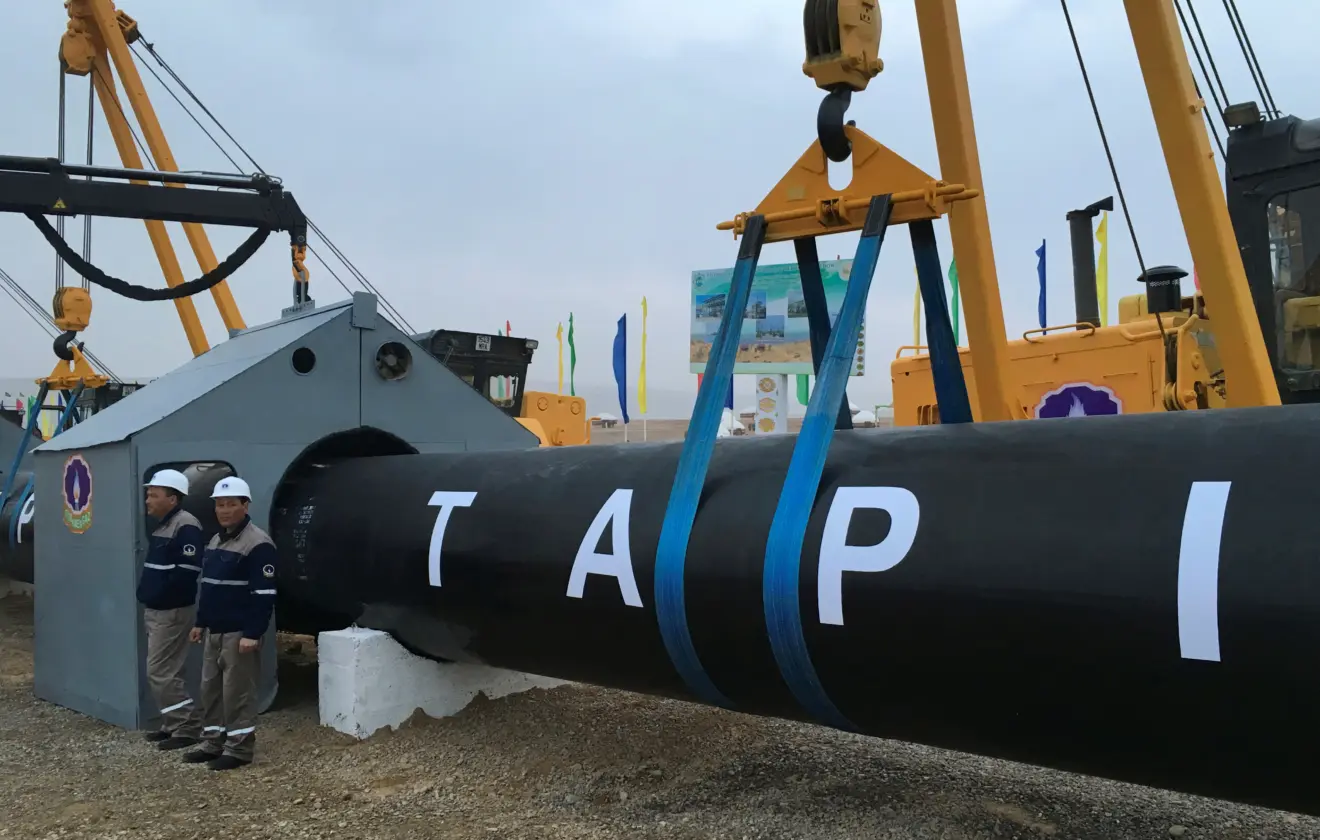
ASHGABAT, Nov 26 – Turkmenistan expects to finish a section of the TAPI pipeline to the Afghan city of Herat by the end of the year, officials said. It hopes the step will draw international lenders to extend the gas route as far as Pakistan and India.
The Turkmenistan-Afghanistan-Pakistan-India gas pipeline has been planned for decades. Analysts, investors and industry figures have long called it unrealistic because of conflict in Afghanistan and the bitter rivalry between India and Pakistan.
So far, Turkmenistan has paid for the work itself.
Turkmen officials say the Herat section, under construction since 2024, should start pumping gas to Afghanistan’s third-largest city in early 2027. Afghan media put its cost at about $600 million.
Turkmenistan says it has welded and laid around 124 kilometers of the 153-kilometer stretch from Serhetabat, on the Turkmen border, to Herat. That nearly completes the first Afghan leg, but it is less than a tenth of the planned 1,800-kilometer route to Pakistan and India.
The full project is designed to carry 33 billion cubic meters of gas a year. That is 66 times the 500 million cubic meters Turkmen officials say Afghanistan is expected to purchase annually in the initial phase
That would leave plenty of spare capacity for the much bigger markets of Pakistan and India. The two countries import around 45- 50 billion cubic meters of gas per year. Almost all of it arrives by sea as liquefied natural gas.
Analysts have put the total cost of the pipeline at around $10 billion. They say investors will be wary because most of the world, including Turkmenistan, does not recognize the Taliban government in Afghanistan.
But Turkmen officials said higher energy prices may help. They said the war involving the United States, Israel and Iran has raised demand for supplies from outside the Middle East, and that this could spur new interest in the route.
Turkmenistan holds the world’s fourth-largest gas reserves, and it is almost entirely dependent on China as a buyer for its gas exports. Extending the pipeline would give it new markets.
Muhammetmyrat Amanov, head of the Turkmen state company, is in charge of the project, said the Herat section should “provide early revenue streams and increase confidence among lenders.”
Amanov named the Asian Development Bank and the Islamic Development Bank as possible funders.
The Islamic Development Bank did not reply to a request for comment, while the Asian Development Bank was noncommittal. It said it paused regular aid to Afghanistan after the Taliban returned to power in 2021, but it remains engaged with the project and any funding would depend on conditions at the time.
Afghanistan’s state gas company said in August that it had signed a preliminary deal to buy gas delivered to Herat, but it did not give a price.
Officials in Herat welcomed the plan.
“TAPI brings with it the promise of economic growth,” the governor’s office said.
It added that the pipeline would bring jobs and help develop the country’s infrastructure.
A Western diplomat based in Ashgabat, who spoke on condition of anonymity, said selling as much gas as possible to China might seem the simplest and safest choice in purely commercial terms.
“Excessive dependence on a single buyer is an existential strategic risk,” the diplomat said.
The diplomat said such reliance would give a single buyer enormous leverage over Turkmenistan’s entire economy.
Other export routes face hurdles too. A proposed line across the Caspian Sea to Europe faces political and technical problems, mainly over how to divide the seabed.
Security in much of Afghanistan has improved since the Taliban returned to power. Ashgabat keeps fairly friendly ties with Kabul, even though it does not formally recognize the Taliban government.
The bigger obstacles lie further south. Pakistan’s long rivalry with India and its current conflict with the Taliban authorities in Afghanistan both stand in the way of the full project.
And a decades-long separatist insurgency in Balochistan, which is now growing stronger, poses another problem. The pipeline’s planned route runs through the Pakistani province.
Faryal Leghari, Pakistan’s ambassador to Turkmenistan, said Islamabad remains interested in the pipeline. She said Pakistan is also interested in a related plan to carry Turkmen gas to its ports of Gwadar and Karachi, where it could be shipped as liquefied natural gas.
India’s foreign ministry did not immediately respond to a request for comment.
The Western diplomat said raising international money would be extremely hard, but that Ashgabat was not giving up. Turkmenistan is willing to spend its own money on the TAPI pipeline up to the Afghan border and some distance beyond, the diplomat said, to keep the project alive and draw in partners later