Zelensky Tells BBC Washington Is Favouring Middle East Over Ukraine’s Air Defence
Zelensky tells the BBC that the US focus on the Middle East has left Ukraine short of air defence, and questions Trump calling Putin a friend.
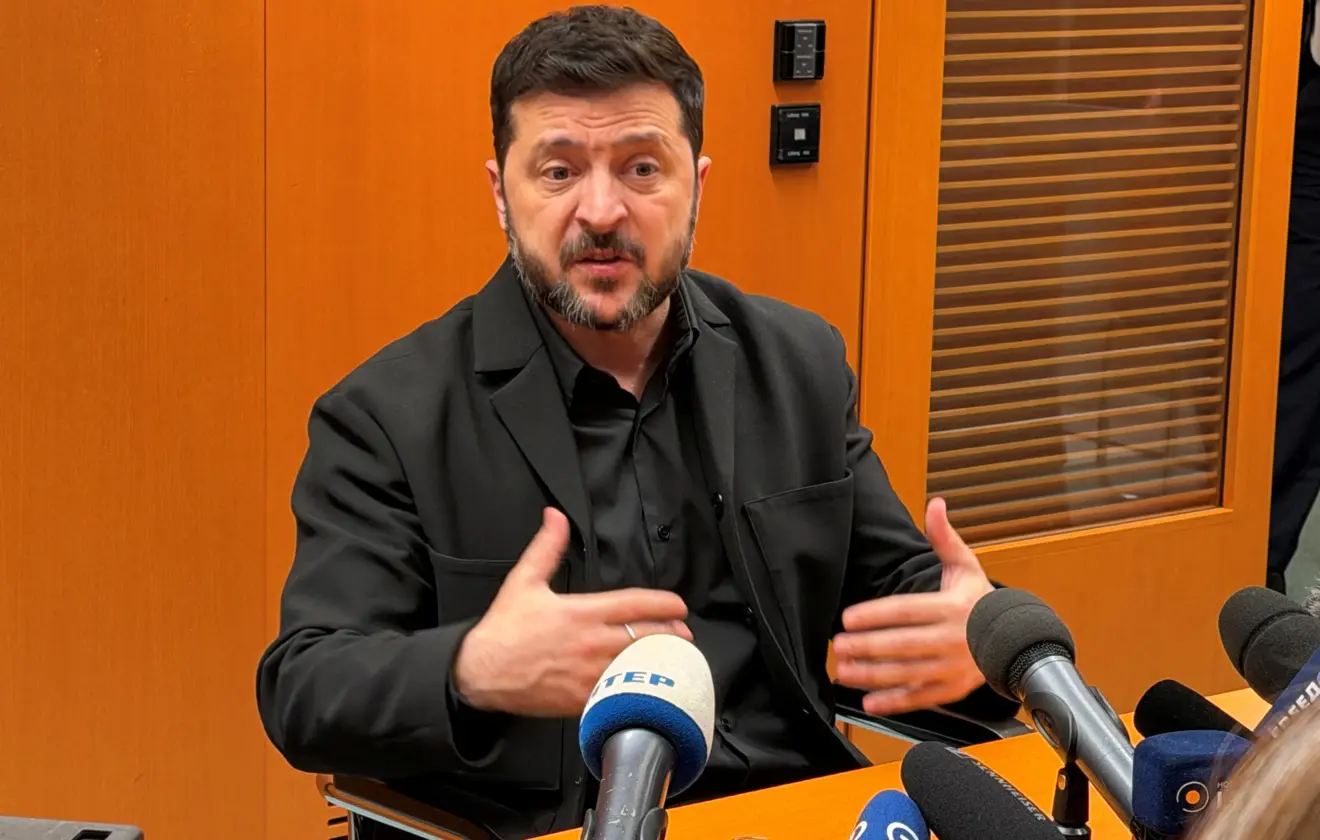
KYIV, Nov 26 – Ukrainian President Volodymyr Zelensky has accused the United States of holding back Patriot air defence deliveries while it concentrates on the Middle East, warning in an exclusive interview with the BBC that the resulting shortage of anti-ballistic interceptors is costing Ukrainian lives. Speaking at his office in central Kyiv, he also said Washington was failing to press Russia hard enough in US-brokered peace talks.
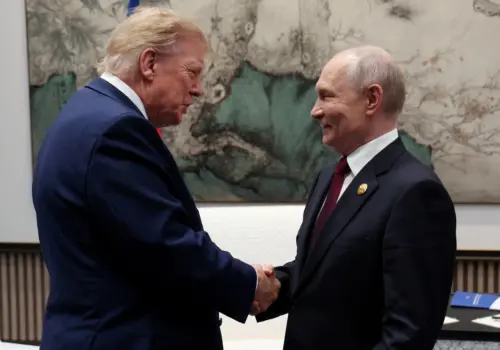
In the same interview, Zelensky questioned President Donald Trump’s decision to post a photograph of himself embracing Vladimir Putin, captioned my friend”. Zelensky told the BBC the gesture was “strange”.
His sharpest criticism in the BBC interview concerned air defence. Zelensky described Ukraine’s shortfall of interceptor missiles capable of stopping ballistic missiles as “very, very big”, and said the Americans were delaying deliveries of their Patriot systems.
He linked the delay directly to US priorities elsewhere. “It’s a pity they made a focus on the Middle East, and they help them more,” he said, adding that Kyiv had “huge questions” about the decision.
“The deficit of these missiles – that is people’s lives.”
The shortage comes as Russian bombardment intensifies. Strikes across Ukraine are becoming both more frequent and more lethal, and the number of civilians killed has reached an all-time high.
Russian ballistic missiles are being aimed at power stations and bridges, while jet-powered drones are sent towards central Kyiv and other major cities every day. For residents of the capital, air-raid alerts sounding around the clock have become a wearying part of normal life.
Zelensky offered one encouraging figure. Ukrainian forces, he said, can now destroy roughly 70% of Russia’s fastest drones, and that rate is rising. Ballistic missiles, however, remain a far harder threat to counter without the interceptors Kyiv says it lacks. Ukraine, for its part, is answering with drones of its own, launching hundreds at targets inside Russia.
Zelensky also confirmed to the BBC that access to Starlink, the satellite communications network run by SpaceX, and to Starshield, its military counterpart, remains restricted in the occupied parts of Ukraine.
Ukrainian drone crews have separately told the BBC that the restrictions have weakened their defences. Their interceptor drones can no longer keep pace with Russian Shahed drones, they said, leaving those weapons free to travel deeper into Ukrainian territory.
Asked who had decided to impose the limits, Zelensky said responsibility was unclear, likening the process to a game of ping pong in which each side in Kyiv points to the other.
“Technically SpaceX, politically – I don’t know, I really don’t know.”
His remarks on Trump’s post were unusually direct for a leader who has trodden carefully in his dealings with Washington since a bruising Oval Office meeting with Trump in 2025.
Acknowledging that it was the American president’s choice, Zelensky nonetheless rejected the idea that Putin was acknowledged as a friend. “He’s an aggressor, and a killer,” he told the BBC, comparing it to claiming friendship with Adolf Hitler during the Second World War.
He extended that argument to Washington’s broader stance in the negotiations. The US describes itself as neutral, saying that neutrality is necessary to secure a peace settlement both sides can sustain. Zelensky disputed that framing.
“When you try to be very neutral with the aggressor… it means you support victims and you support also the aggressor. It’s not right.”
Instead, he called for “real helpful allies, who can push Russia” to deliver results, and urged the United States to act in keeping with its standing as a powerful nation commanding “power and respect”.
Two envoys appointed by Trump have been working to broker an agreement between Moscow and Kyiv to end the heavy loss of life. Their positions, however, have often appeared closer to Russia’s than to Ukraine’s.
The most recent round of negotiations, held with mediation in Abu Dhabi earlier this month, produced no visible breakthrough. Zelensky summed up the experience in a single line: “The more we know, the more problems.” He said talks were expected to resume in December.
It also remains unclear whether European negotiators will take part. The US envoys had said they would be involved, but Zelensky told the BBC that this had not been settled, and the Kremlin appears to be resisting their participation.
Russia’s public statements suggest it has returned to the hardline demands it laid out at the start of negotiations on every issue under discussion.
Trump has struck a more hopeful tone. On Thursday, he wrote on his Truth Social platform that, during his summit with Putin in China last week, he had urged Russia to “pull back all military aggression against territories throughout Europe.” He added that he saw a peace deal with Ukraine as “a strong possibility.”
For Ukraine, progress is urgent. The country is seeking an end to Russia’s full-scale invasion, which has now lasted almost five years.
Kyiv has also intensified its long-range campaign in recent weeks, striking Russian oil refineries as well as ships carrying weapons or fuel.
One such operation drew a sharp response from Rome. Italian Prime Minister Giorgia Meloni said on Thursday that this week’s attack, which sank a Russian warship moored in eastern Libya, threatened to extend the war into the Mediterranean, an outcome she called unacceptable.
Zelensky defended the strike, describing the warship, the Merkury, as an “absolutely fair target.”
He acknowledged that such operations were “very dangerous,” but said Ukrainian forces “never attack” without coordinating with partners. He declined to provide further details.
Recent Russian attacks on Kyiv have targeted bridges spanning the Dnipro River, in what appears to be an attempt to divide the city in two. Power cuts and strikes on supply networks have driven business costs to levels many companies cannot sustain, forcing some to close and leaving large parts of the capital without electricity. Some residents have already left for the winter.
Zelensky told the BBC that driving people out was precisely Russia’s aim. While residents were free to leave, he said, the government would defend the capital by every available means.
“We need our capital. Without a capital, you don’t have a country.”
With negotiations due to restart in December, Ukraine enters the colder months still pressing its allies for the interceptors it says it needs and for a firmer line from Washington towards Moscow.