North Korea Launches Around 10 Short-Range Ballistic Missiles Before Border Loudspeaker Deadline
Seoul says the missiles flew about 250 kilometers from the Wonsan area. The launch comes as Pyongyang’s deadline to activate border loudspeakers approaches.
SEOUL, Oct 29 – North Korea fired roughly 10 short-range ballistic missiles toward waters off its east coast on Thursday, South Korea’s military said, amid rising tensions over a border loudspeaker deadline.
South Korea’s Joint Chiefs of Staff said the missiles were launched at about 12:30 p.m. local time from the area around Wonsan, a city on North Korea’s eastern coast. The military said they flew about 250 kilometers, or 155 miles, before falling into the sea. Some early reports from Seoul put the number at around a dozen, and the final count may change once the analysis is complete.
The Joint Chiefs of Staff said South Korea had stepped up surveillance and remained ready for further launches. It added that Seoul was sharing information closely with the United States and Japan.
Japan’s Defense Ministry said it detected what appeared to be a ballistic missile launch. It said the projectile did not seem to have landed inside Japan’s exclusive economic zone.
In Seoul, the presidential National Security Office held an emergency meeting to review the security situation after the launch. It urged Pyongyang to stop its repeated missile tests, which it called a “serious violation” of United Nations Security Council resolutions.
Analysts said the short-range ballistic missiles appeared to be part of a wider pattern of North Korean shows of force along the tense border, rather than a reply to any single incident. Kim Yong-hyun, a professor of North Korean studies at Dongguk University in Seoul, said the test also seemed designed to show off Pyongyang’s advancing missile capabilities to the United States, Japan and the wider international community.
Relations along the inter-Korean border have worsened sharply since two mine explosions inside the Demilitarized Zone on September 21, and reports say some South Korean soldiers were injured in the blasts. Seoul says North Korean troops planted the mines, and a joint investigation by South Korean and United Nations officials reportedly reached the same conclusion earlier this month. South Korea has called the incident a violation of the armistice that ended fighting in the 1950-53 Korean War, and it has demanded an apology. Pyongyang has denied any involvement and accused Seoul of fabricating the incident.
Last week, Kim Yo Jong, the influential sister of North Korean leader Kim Jong Un, said Pyongyang would put loudspeakers able to broadcast anti-South Korean propaganda on standby along the border within days. A day earlier, she had said the broadcasts would begin along the entire frontier by the end of October.
But analysts in Seoul doubt the devices will actually be switched on. Lim Eul-chul, a professor at Kyungnam University, said North Korea did not appear to have made a firm decision to start broadcasting. Instead, he said, Pyongyang seemed to be getting everything ready so that it could watch how South Korea responds.
Both Koreas have used loudspeakers to send propaganda across the border for decades. The government of South Korean President Lee Jae Myung halted its own broadcasts and removed fixed border loudspeakers last year, and North Korea then suspended its broadcasts as well.
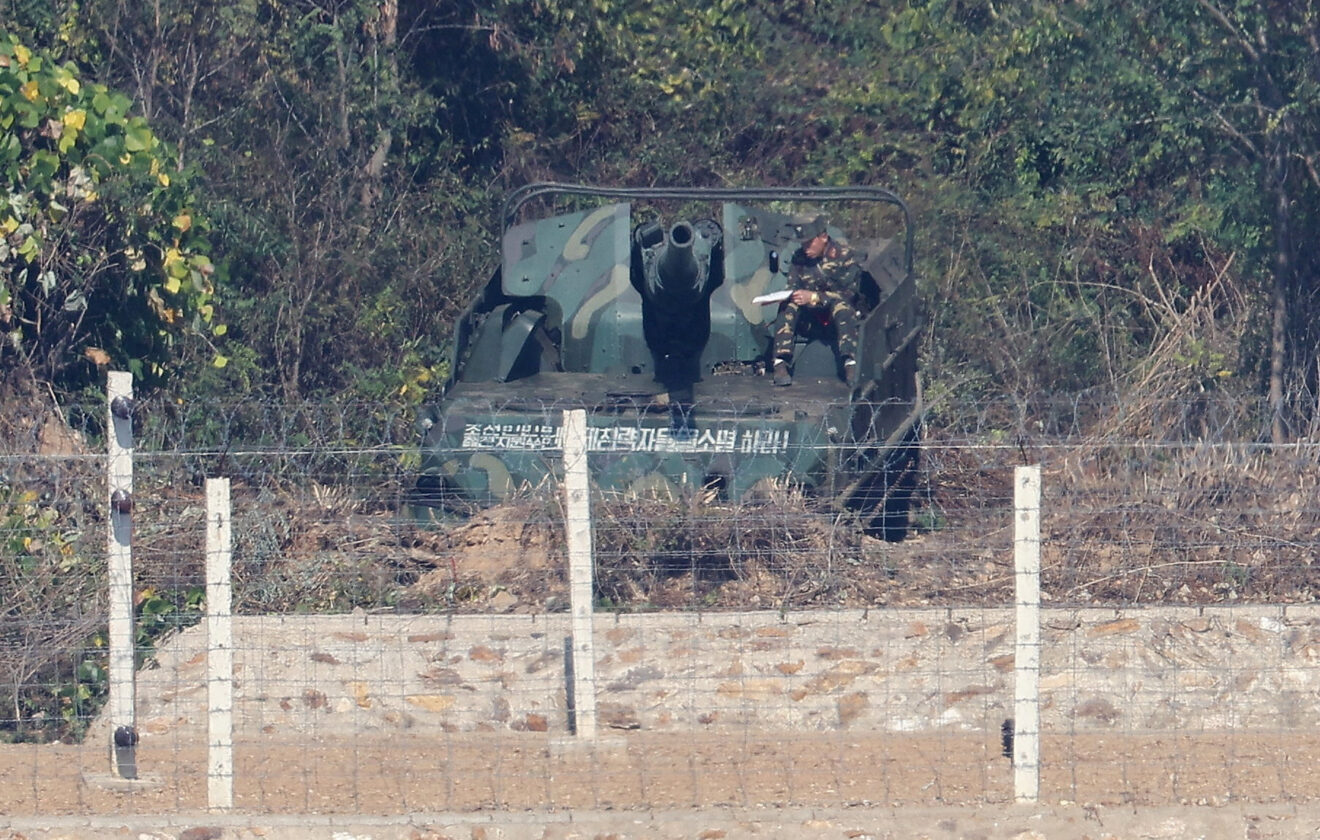
North Korea has also placed artillery batteries in spots that can be clearly seen from the southern side of the border. South Korea’s military said the move appeared mainly intended as a display of force. Joint Chiefs of Staff spokesperson Jang Do-young said the exposure of older weapons systems should be understood as being “for show.” Defense Ministry spokesperson Chung Binna said placing artillery where it could easily be spotted made little sense in tactical or military terms.
Witnesses this week saw three North Korean armored vehicles near the border with their barrels pointed south. South Korean experts identified them as self-propelled 122-millimeter howitzers. North Korean soldiers were also seen putting up fences inside the Demilitarized Zone.
Jang said North Korean activity near the Military Demarcation Line, which runs through the zone, was continuing. He said South Korean forces had issued warning broadcasts and fired warning shots when North Korean troops crossed the line. Seoul has reported about 50 such crossings this year.
Seoul said it was still awaiting a response to two proposals for military talks and has urged Pyongyang to return to dialogue.
North Korea last fired ballistic missiles on October 12, and it has carried out missile tests on more than 10 occasions this year.