Jordan Church Shooting Kills Seven at Karak Funeral in Terrorist Attack
Gunmen opened fire on mourners outside a Greek Orthodox church in southern Jordan, in a rare attack on the country's Christian minority that officials describe as terrorism.
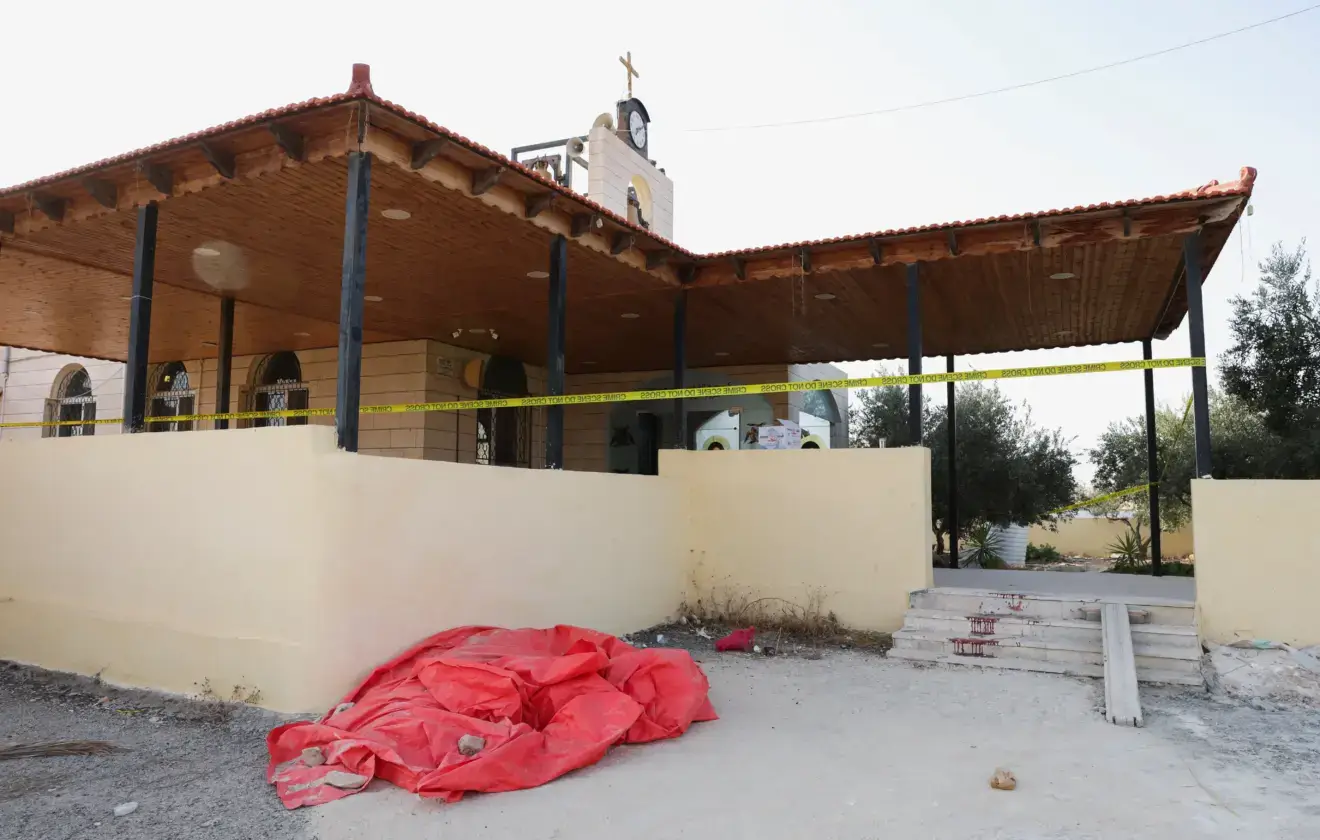
A Jordan church shooting during a Karak funeral killed seven people and wounded dozens on Friday, October 23, in what authorities called a terrorist attack. It is a rare and deadly strike on the country’s Christian minority.
The attack took place at the Greek Orthodox church in Hamoud, a village in Karak governorate, about 180 kilometers, or 110 miles, south of the capital, Amman. Mourners had gathered for a funeral procession when the gunmen opened fire from outside the building. Officials said the shooting lasted for several minutes. The attackers then fled.
The number of wounded is still unclear. Jordan’s health minister, Ibrahim al-Budour, said 40 people were hurt, and two of them are in critical condition. Interior Minister Mazin Al Farrayeh gave a figure of 34. Major General Obeidallah Maaytah, head of the Public Security Directorate, told reporters that 27 of the wounded were still being treated in hospitals. He said security forces were running a major search operation to find and arrest the attackers.
Al Farrayeh described the attackers as extremists but said it was too early to know whether they had links to militant groups inside or outside Jordan. Nobody has claimed responsibility. Officials have not released the names of the victims or a full breakdown of their injuries, and they have not said whether the gunmen acted alone or as part of a wider network.
Video aired by the state-owned Al-Mamlaka television station, which appeared to come from a security camera at the church, showed three men firing toward the building from a sidewalk. It showed the attackers taking cover behind trees and a low wall before running toward the entrance. Jordanian state television said two of them appeared to hold pistols and a third carried a semiautomatic rifle. Reuters said it verified the video by matching details such as the path to the entrance and the wall around the church.
Two eyewitnesses described the scene to Al-Mamlaka. Khaled Burqan, who was at the funeral procession, said dozens of people were present when the gunmen began shooting. “They opened fire on us for several minutes,” he said. Ihab Ammareen described a chaotic and horrifying scene in which bloodied people collapsed on the floor. “People were crying, wailing, screaming — it’s hard to describe,” he said. Other survivors said they heard an explosion when the procession began, followed by masked attackers who broke in and kept firing. Dorgham Halasa, another mourner, said the gunfire started about 15 minutes into the service, and people began to run. Footage from inside the church afterward showed blood on the floor near the entrance, where security forces had deployed.
Prime Minister Jafar Hassan spoke after an emergency security meeting in Karak. He said the attack was “a result of a terrorist ideology and blind extremism,” and that the state would use all its resources to bring those responsible to justice. He added that the security apparatus would strike back against anyone trying to sow sedition. The government is treating the shooting as an act of terrorism. That label gives Jordanian security agencies broader investigative powers and allows harsher penalties.
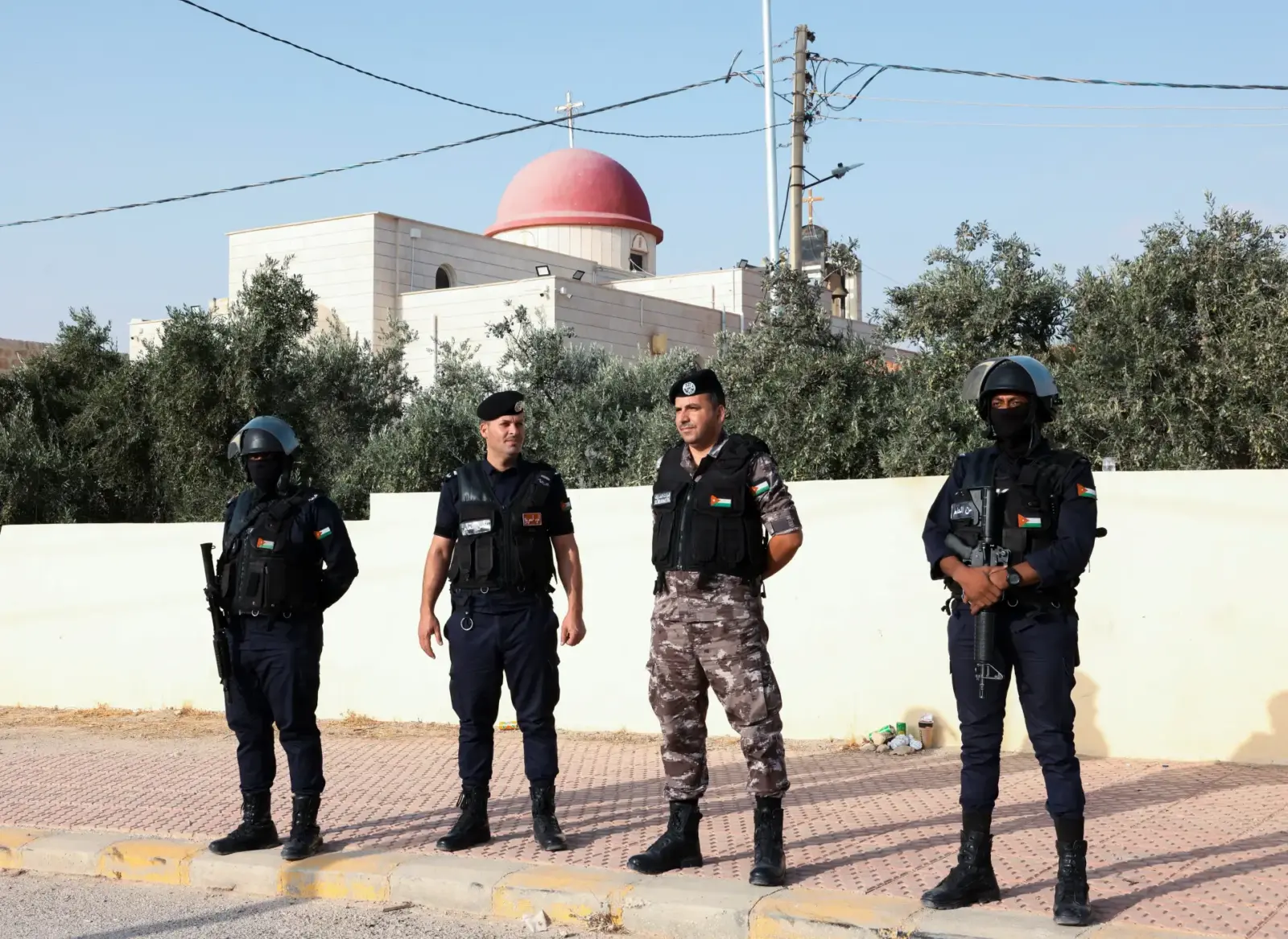
Security personnel stand outside Saint George’s Greek Orthodox Church, where gunmen opened fire during a funeral the previous day, in the village of Hamoud, Karak, Jordan, October 24, 2026. REUTERS.
King Abdullah II traveled to Karak within hours. He said on X that Jordan “will confront the terrorist act that targeted Karak with the harshest penalties.” He offered condolences to the families of the dead and wished the wounded a swift recovery. In a separate statement, he said those who think they can divide Jordanians with bullets have no chance against the country’s unity, and that the attackers would be punished “with an iron fist.” The king is a key partner of the United States in regional efforts against militant Islamist groups.
International reaction came quickly. United Nations Secretary-General Antonio Guterres called the attack “especially heinous.” Mike Waltz, the American ambassador to the United Nations, called it a “depraved and brutal attack on a house of worship.” He offered prayers for the victims and their families and said the rising number of attacks on Christians around the world must stop. The American Embassy in Amman issued a security alert. It said security had been stepped up at shopping malls, foreign embassies and other sensitive sites in the capital, and told American citizens to expect a stronger police presence across Jordan.
In Karak, people gathered at the local government hospital to support the wounded and wait for news of relatives and friends. Many said they were angry and in disbelief, because attacks on churches are extremely rare in Jordan. Hani Al-Mbaydeen, one of those at the hospital, said people were unable to find words. His only reproach to the state, he said, is that it must examine where these ideas come from and how they get into the minds of the country’s children.
Karak is a historic town known for its Crusader-era castle and for its Christian community. It has seen violence before. In December 2016, gunmen carried out a series of attacks in the town, including at the castle, a popular tourist site, and killed at least 10 people, among them police officers. Security forces killed the attackers after a long standoff.
Jordan is one of the more stable countries in the Middle East and has largely avoided the mass-casualty attacks that have struck neighboring Iraq and Syria. Authorities say they have foiled attempted attacks by Islamist militants repeatedly in recent years. This church shooting stands out for its toll and for its target, a church during a funeral in a country that promotes itself as a model of coexistence between faiths. Christians are a small minority in Jordan, but the country is important to Christians worldwide, with several biblical sites, including places along the Jordan River traditionally linked to the baptism of Jesus.
The attack comes at a tense time for the region. Jordan has been repeatedly caught in the crossfire of Iranian missile strikes this year, after the United States and Israel launched strikes on Iran in February. On March 31, the Royal Jordanian Air Force intercepted four missiles launched from Iran. In June and July, Iran’s Revolutionary Guards targeted the Al-Azraq air base, and Jordan’s air defenses shot down several ballistic missiles. In September, Jordan intercepted a barrage of 18 Iranian ballistic missiles, which drew condemnation from neighboring countries, including Saudi Arabia. Officials have not suggested any connection between the church shooting and the regional conflict. The country borders conflict zones and hosts a large refugee population.
Jordanian officials have urged calm and unity and said the attack must not inflame sectarian tensions between Muslims and Christians. Security forces remained deployed around the church and at key sites in Karak on Friday night. Authorities said they would release more details as the search for the attackers continues.