Israel Election Explained as Netanyahu Faces Gadi Eisenkot in a Close Vote
Israelis vote on Tuesday to decide whether the longest-serving prime minister stays in office or gives way to a former military chief, though analysts expect little change in policy.
Israel’s election on Tuesday, October 27, will decide whether Benjamin Netanyahu stays prime minister or is replaced by former military chief Gadi Eisenkot. The vote could change who leads Israel. Analysts say it will probably not change what Israel does.
Why this vote matters
It is the first Israeli election since the Hamas attack of October 7, 2023. That attack set off wars in Gaza, Lebanon and Iran. It is also the first in 38 years to run to the natural end of a full Knesset term.
Many Israelis see it as a referendum on Netanyahu himself. The country is split between those who back him and those who want him gone.
Who is running
Netanyahu has dominated Israeli politics for three decades. He has been prime minister for about 19 of the past 30 years. He leads the right-wing Likud party. His allies include ultranationalist parties.
Eisenkot is a former chief of staff of the Israel Defense Forces. He entered politics only four years ago. He leads a new party called Yashar, which means “straight.” He calls himself the anti-Netanyahu candidate. He wants “a country without lies” and a term limit for prime ministers.
Two former prime minister-level rivals of Netanyahu stand with the opposition. Naftali Bennett leads a party called B’Yachad, or “Together.” Avigdor Lieberman leads Yisrael Beiteinu. Both worked closely with Netanyahu once. Both broke with him later.
On the far right, Itamar Ben-Gvir leads the Jewish Power party. He wants more settlements in the West Bank and harsher measures against Palestinians. His supporters want Netanyahu pushed further right.
How the voting works
Israelis do not vote for a prime minister. They vote for parties. The Knesset is Israel’s parliament and has 120 seats. These seats are allocated to political parties according to the share of votes each party receives in the election.
A government needs 61 seats. No party wins that many alone. So the leader who can build a coalition becomes prime minister. That makes the deals after the vote as important as the vote.
What the polls say
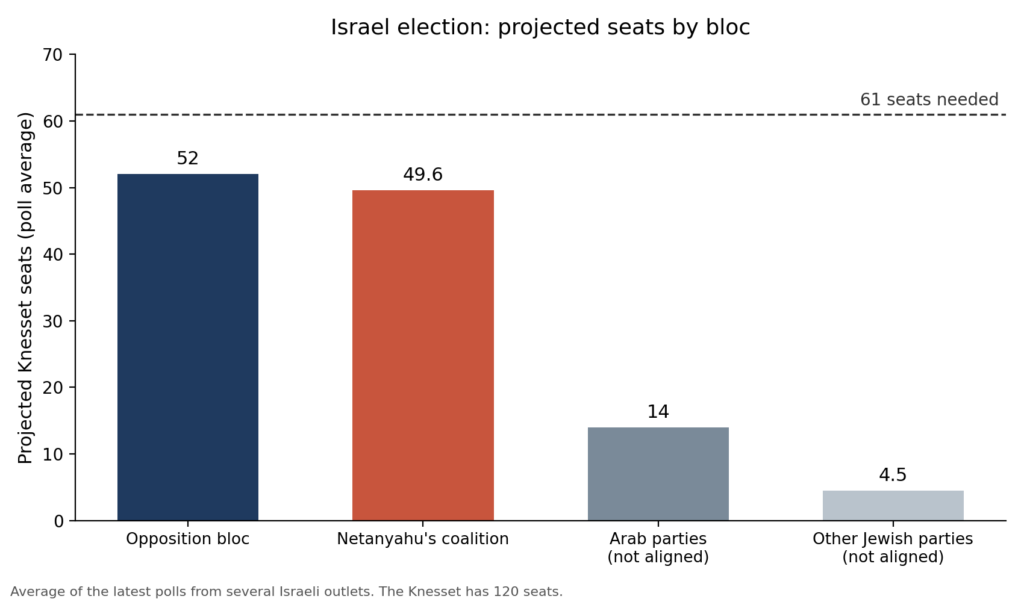
Eisenkot’s Yashar leads most polls. The latest average gives it about 22 seats. Likud has about 20. Bennett’s party has about 13. The chart file, israel-election-projected-seats-by-bloc, shows the totals for each side. The table has the same numbers.
| Bloc | Projected seats |
|---|---|
| Opposition bloc | 52.0 |
| Netanyahu’s coalition | 49.6 |
| Arab parties, not aligned | 14.0 |
| Other Jewish parties, not aligned | 4.5 |
The opposition leads by a small margin. Neither side reaches 61. The final television polls on Friday gave the opposition a lead of two to six seats, but none gave it a majority.
That means the small parties may decide who governs. A poll for the newspaper Maariv found that most Israelis would prefer a unity government to a new election if the vote ends with no clear winner.
Why Netanyahu is still strong
He has faced heavy criticism. People blame him for the failures of October 7. They point to the wars, his push to weaken the Supreme Court, and his corruption trial. They also point to a scandal known as Qatargate, which involves allegations against close aides.
His core voters stayed loyal. He has tried to shift the blame for October 7 to military and intelligence chiefs. He says he alone can protect Israel.
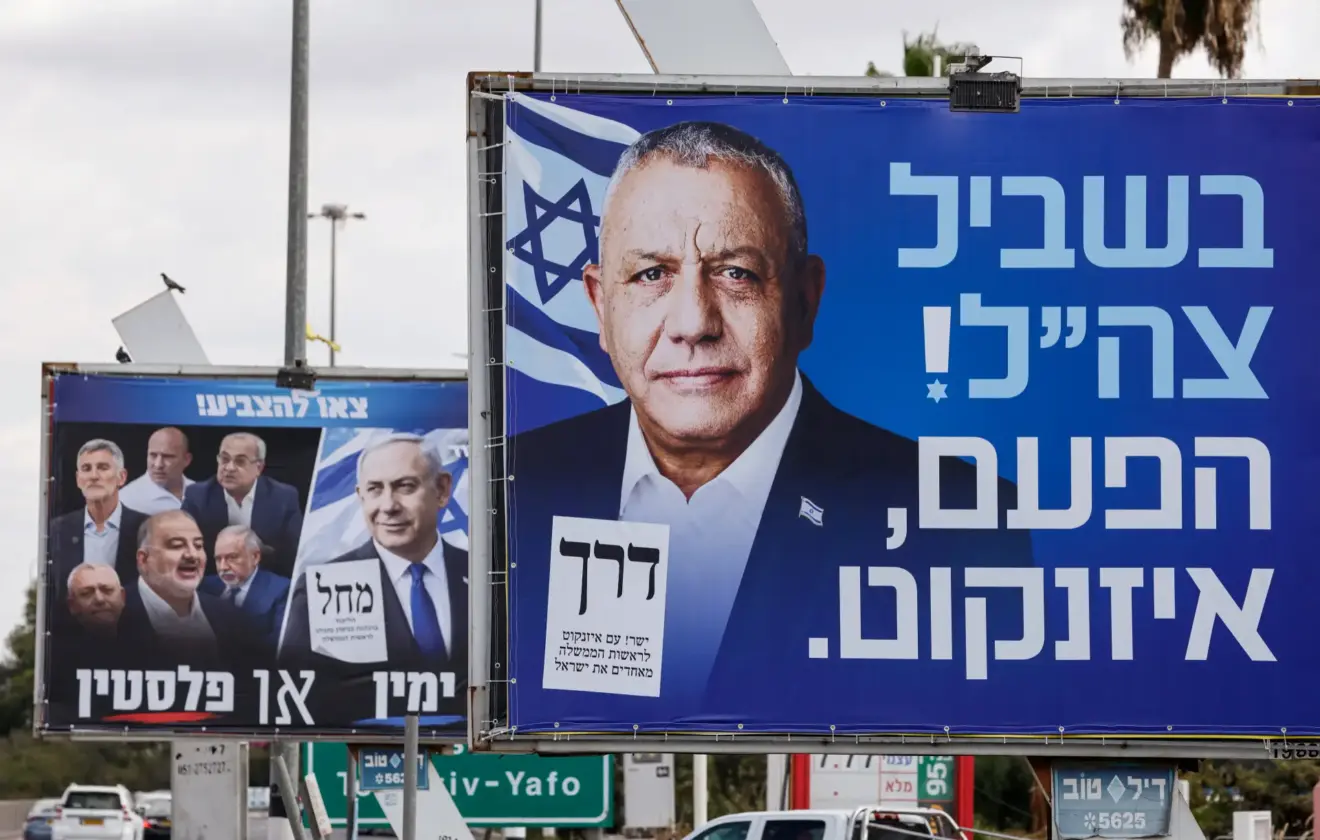
His campaign has painted the vote as a choice between a strong right-wing government and a weak alternative. One poster told voters to choose between “the right” and “Palestine.” Critics say this treats the opposition as soft on security.
Netanyahu’s critics also say his policies have isolated Israel and failed to meet their goals. They say Hamas is not destroyed. They say Iran’s nuclear threat remains. They say Israel’s standing abroad has suffered.
President Donald Trump publicly endorsed Netanyahu on October 18. He called him a “great warrior prime minister.”
What is at stake
If Netanyahu wins, expect more of the same. He would keep expanding settlements, pressing Iran, and putting military pressure on Hamas and Hezbollah. He says Israel must put “prevention and offence over containment and defence.” That includes striking threats before they grow.
He has also said his goal goes beyond containing Iran. At a military ceremony, he said the way to end the threat was to “overthrow the regime in Iran.”
If Eisenkot wins, the tone may change. He could try to repair Israel’s standing abroad and ease some settler violence. But analysts expect little change in substance. The Palestinian analyst Ghassan al-Khatib said Israeli parties are competing to look tougher on security. Most oppose a Palestinian state and support more settlements.
Iran at the center
Israel treats Iran as its main enemy. Netanyahu calls it the central threat and wants to weaken or topple its government. He has made security his main message in the campaign.
Hezbollah and Hamas are weaker after the wars. But Iran’s wider network of allied groups has survived. Some analysts warn that the pressure may push Iran toward a nuclear deterrent.
Experts doubt that anything short of a full invasion would make Iran drop what it sees as its core interests. After months of war, Tehran may think it can outlast its opponents. Michael Young of the Carnegie Middle East Center called the situation a quagmire.
How Arab states see it
Many Gulf leaders dislike Netanyahu’s policies in Gaza, the West Bank, Syria and Lebanon. But they see him as the Israeli leader most likely to keep pressure on Iran.
That is a dilemma. They want Iran contained. They also fear his actions could destabilize the region. Abdulaziz Sager of the Gulf Research Center said a settlement with Iran was needed before the conflict grew worse.
The Palestinian question
The election is unlikely to change Israeli policy toward Palestinians. Most parties want a tougher line on security and settlements.
Washington says it does not support Israel annexing the West Bank. Palestinian anger is still growing. Settler violence, military raids and the lack of any path to statehood feed it. Joost Hiltermann of the International Crisis Group warned that even a small incident could spark a wider uprising.
What comes next
If Netanyahu holds power, expect a security-first strategy. That means pressure on Iran and little movement on Palestinian statehood. If the opposition wins, the style may soften, but the core policies are expected to stay.
Coalition talks could take weeks. Netanyahu could stay on as caretaker prime minister while parties bargain, or if the vote ends in a stalemate.
Israel’s election will decide who leads the next government. For many Israelis, it is about Netanyahu more than about left or right. For the region, the election is a test of whether real change is possible, or whether the same long-running confrontation will continue.