Haley Stevens Endorses Mike Rogers in Michigan Senate Race
The congresswoman who lost the Democratic primary to Abdul El-Sayed backed his Republican rival on Sunday. A new poll still shows El-Sayed ahead.
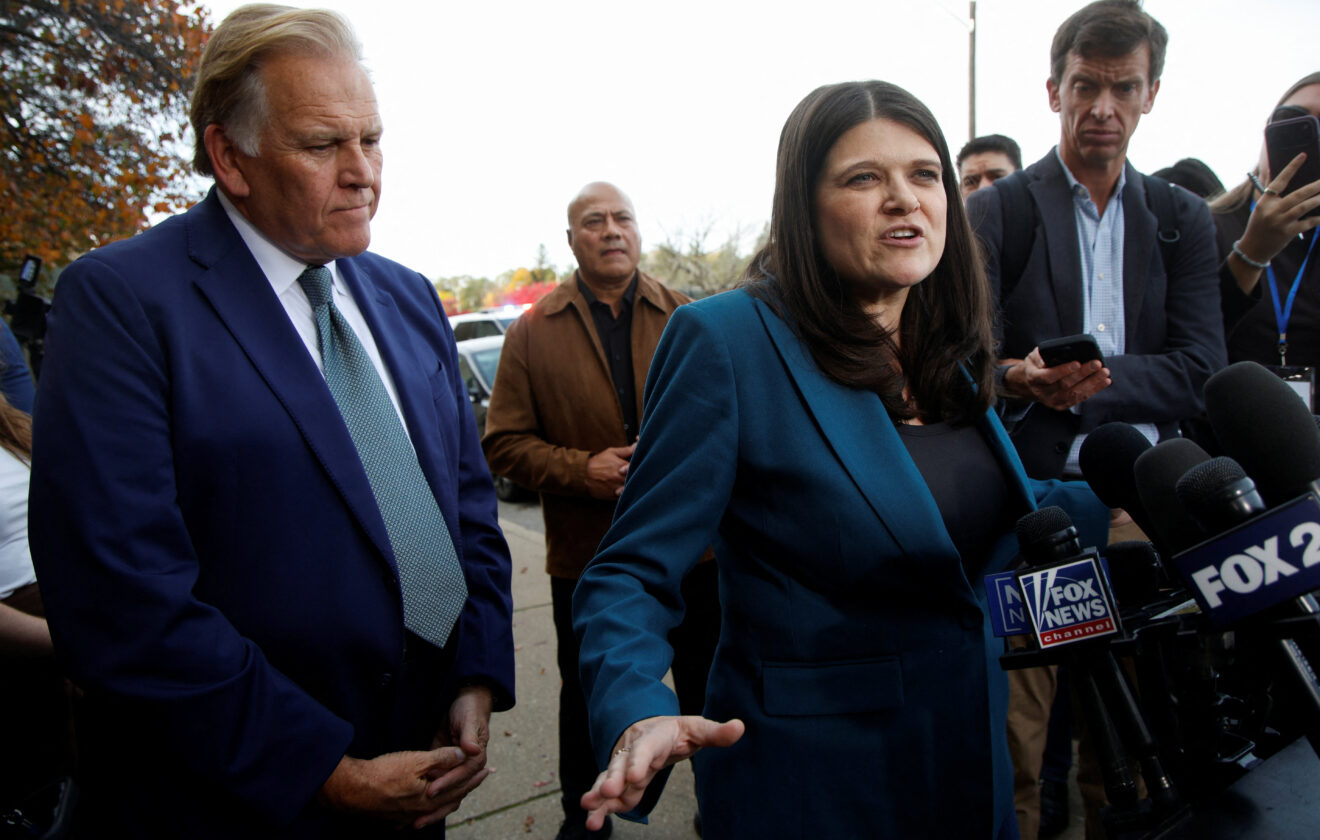
DETROIT, Nov 2 – A prominent Michigan Democrat has endorsed the Republican candidate in one of the country’s most closely watched Senate races, just two days before Tuesday’s midterm elections.
Haley Stevens, a member of the United States House of Representatives, endorsed Republican Mike Rogers on Sunday, appearing alongside him at a church service in Detroit. Stevens had lost the Democratic primary for the seat in August to Abdul El-Sayed after a bitterly contested race.
“I don’t belong in Abdul’s campaign,” Stevens said in a video posted on social media.
Her endorsement gave President Donald Trump’s Republicans an unexpected boost in a state viewed as central to Democrats’ hopes of retaking the Senate. It also threatened to deepen divisions within Michigan’s Democratic Party, where tensions between Stevens and El-Sayed had already been running high since the primary.
Hours later, at a rally in Iowa, Trump invited Stevens to join the Republican Party. He told reporters earlier that he planned to call her to thank her, describing the endorsement as a smart move and claiming that Abdul El-Sayed would “destroy the country.”
Stevens had been expected to appear alongside El-Sayed on Sunday in a display of party unity. That plan collapsed after her surprise endorsement, leaving Democratic leaders scrambling to contain the fallout.
Earlier in the week, she had called on Abdul El-Sayed to condemn an ad by an outside group. She said the ad blamed Israel for high grocery prices. Abdul El-Sayed later rejected the ad’s message. But his campaign had already asked her to stay away from his events until Election Day, so that she would not distract from the main issues, a person familiar with the matter said. On Friday night, Mike Rogers called her and said he would welcome her support, according to a report by Axios.
Haley Stevens told CNN on Sunday night that the ad had been very painful. She said many Democrats want to vote for the party’s nominee, but feel they are being told they don’t belong.
Mike Rogers praised her. He called the endorsement an act of courage. He said that when even a small part of a party turns to hate against a group of people, it becomes dangerous.
At the Iowa rally, Trump again called Abdul El-Sayed a “jihadist.” There is no evidence for that label. Critics say it fits a wider pattern of attacks on Arab Americans and Muslims by Trump and other Republicans.
The endorsement did not seem to hurt Abdul El-Sayed in the polls. A New York Times and Siena poll, partly conducted on Sunday, showed him leading Mike Rogers by 53% to 42%.
His campaign also said it raised $1.2 million in the four hours after the endorsement. That was its second-best day of fundraising since the August primary, a spokesperson said.
Abdul El-Sayed did not respond directly to Haley Stevens. Asked about her, he said he doesn’t think about her much. “This race was never about me,” he told the network MS NOW. He said it wasn’t about Mike Rogers or Haley Stevens either. He said it was about the people of Michigan he has met in churches, synagogues and living rooms, and what they need.
Top Democrats rallied behind him. Senate Minority Leader Chuck Schumer said Senate Democrats are united behind Abdul El-Sayed. He said the candidate will fight for working families, and called Mike Rogers a tool of Trump and billionaire donors.
Several members of Haley Stevens’ congressional staff resigned following her endorsement, according to reports from CNN and The Hill. Some voters were also upset. Pamela Johnson, 72, called Stevens a traitor after she voted for Abdul El-Sayed in Warren.
The race is for an open seat, and Republicans have not won a Senate contest in Michigan since 1994.
Control of Congress is at stake in Tuesday’s elections, with all 435 House seats and 35 Senate seats on the ballot. Republicans currently hold narrow majorities in both chambers. Polling favors Democrats in the fight for the House, while the Senate contest remains far tighter and could hinge on a handful of states, including Michigan and Alaska.
If Democrats win either chamber, they could block Trump’s plans for his last two years in office. They could also launch investigations of his administration, which has so far worked with mostly friendly Republican majorities. The White House has been preparing to carry out parts of Trump’s agenda without Congress, including his tariff pressure on trading partners.
In Alaska, the Trump administration suffered a setback on Sunday. A federal judge threw out the Justice Department’s lawsuit, which sought to stop the state from certifying the result if Republican Senator Dan S. Sullivan loses narrowly.
The department had argued that voters could be confused by the presence of a second candidate on the ballot named Daniel J. Sullivan Jr. The controversy escalated last week after The New York Times reported that the campaign of Democrat Mary Peltola had helped recruit him as a potential spoiler. Peltola has denied any involvement, and Daniel J. Sullivan Jr. has said he did not work with her campaign.
Senator Sullivan said on Sunday that he would accept the result of Tuesday’s election, even as the administration moves forward with a criminal investigation. But Alaska’s Republican governor, Mike Dunleavy, has suggested he may refuse to certify a Peltola victory. Senator Sullivan declined to say whether he would support such a refusal.
He repeated the Republican claim that the other Sullivan is a decoy designed to confuse voters. Speaking on CNN’s “State of the Union,” he said he expected to lose a significant number of votes because of what he described as trickery. “Don’t let them get away with the tricks,” he urged Alaskans.