Switzerland and China Sign Upgraded Free Trade Deal During Parmelin’s Beijing Visit
Swiss President Guy Parmelin met Chinese President Xi Jinping in Beijing, where the two countries signed a protocol upgrading their 2014 trade pact. The deal removes Chinese tariffs on almost all Swiss goods.
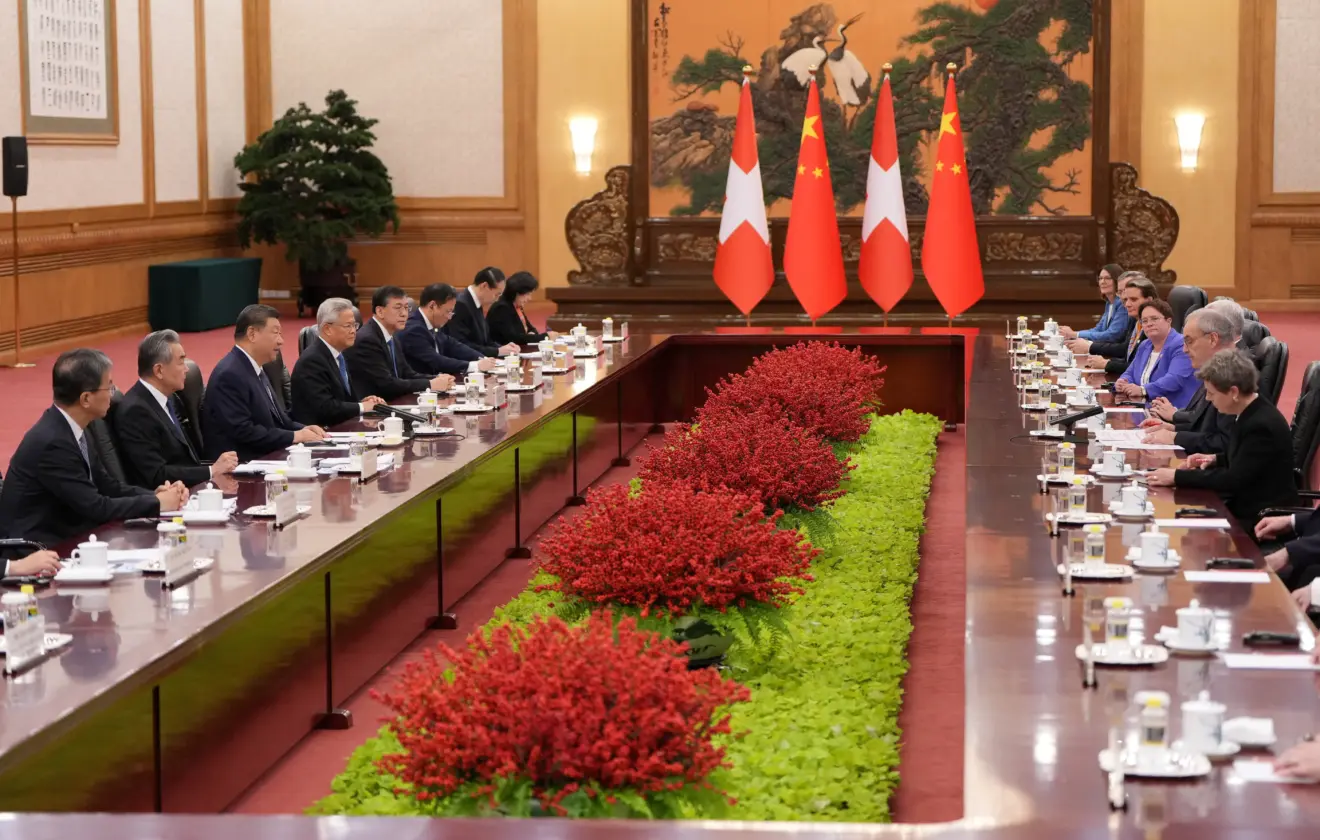
BEIJING, Oct 30 – Switzerland and China signed an upgraded free trade agreement in Beijing on Friday, during a visit by Swiss President Guy Parmelin. The deal will let almost all Swiss exports enter China without tariffs.
Parmelin met Chinese President Xi Jinping before the signing. Speaking at the ceremony, he thanked Xi for his welcome and said the agreements reflected how broad and active the relationship between the two countries has become.
“It is truly an honor and a privilege to be here,” Parmelin said.
The protocol amends the free trade agreement that the two countries signed in 2013 and that took effect in July 2014. It was China’s first free trade agreement with a country in continental Europe.
Under the new terms, 99.8% of Swiss exports will be able to enter China duty-free. Under the old deal, only a little more than half did.
Parmelin said the talks had answered the real needs of Swiss companies. He said the two sides had also built on the rules of the existing agreement in key areas, including digital trade and investment, and he described the negotiations as very efficient.
The talks began in September 2024 and ended after five rounds. Parmelin and Chinese Commerce Minister Wang Wentao announced the deal in Bern in August and signed a memorandum of understanding. The upgraded agreement still has to pass domestic approval in both countries before it takes effect. Until then, the 2014 terms stay in place.
The new deal goes beyond goods. China has opened up more of its market to Swiss firms in several service sectors, including technical testing, financial services, aircraft maintenance and maritime transport, according to business advisers who have studied the text. Switzerland, for its part, has widened access for some Chinese service providers.
The signing comes at a time when many governments are putting up new trade barriers. Switzerland was hit last year by United States tariffs of 39%, the highest in Europe. It later reached a provisional deal with Washington that cut those duties to 15%. The European Union has also grown more cautious about trade with China.
Roger Gschwend, a senior Swiss trade official, said the agreement aims to give Switzerland a level playing field, and that China wants to show it supports trade based on rules. “It’s China sending a signal they are opening up their markets a bit more,” he said.
China’s Foreign Ministry said the upgrade would provide Chinese and Swiss companies more stable, transparent and predictable safeguards for their long-term growth.
Some Western diplomats see the deal as an effort by Beijing to present itself as a champion of open trade. United States officials have asked to discuss the accord with their Swiss counterparts, according to people familiar with the matter. But Switzerland’s government said no specific concerns had been raised.
There have also been concerns that Switzerland could serve as a back door for Chinese goods entering Europe, where many companies already face intense competition from Chinese rivals. The Swiss government said it doesn’t expect the agreement to affect its goods trade with the European Union, the United States or other partners. Gschwend said Switzerland has not been a re-export hub for Chinese goods, and he doesn’t see that changing.
Swiss business groups have welcomed the deal. Some smaller manufacturers expect demand from China to rise, and say customers such as watchmakers and robotics firms could also gain.
China is now Switzerland’s largest trading partner after the European Union and the United States, according to the Swiss government.
In his remarks, Parmelin also looked back at the long history between the two countries. This year marks 75 years of diplomatic ties. Switzerland maintained relations with Beijing in 1950 and was one of the first Western countries to recognize the People’s Republic of China. Parmelin said Switzerland was proud of that role, which he said helped open the way for others.
He also pointed to the innovative strategic partnership that Xi launched in 2016 with Johann Schneider-Ammann, Parmelin’s predecessor on the Swiss Federal Council. That partnership covers trade, research, science and other fields, and it marks its tenth anniversary this year.
The positive trend has continued, Parmelin said. He noted the visit to Switzerland by China’s commerce minister, during which the trade talks were wrapped up. He also said the next strategic dialogue between the two foreign ministers is planned.
But Parmelin said the relationship isn’t only about the economy. Switzerland places great weight on a regular and serious political dialogue with China, he said, including on major international issues.
Talks to update the trade deal had stalled in previous years, amid reports that Switzerland had concerns about China’s human rights record. In 2024, the two countries agreed to resume dialogue between their foreign ministries that was expected to include human rights.
Parmelin’s three-day visit runs through Sunday. He is scheduled to meet Wang, as well as China’s ministers for social affairs, education, and science. He will also meet business leaders and open the 10th Swiss-Chinese Economic Forum, accompanied by a Swiss business and science delegation.
The visit coincides with a trip to China by Germany’s president and is followed earlier this month by the European Union’s top trade official.