Trump arrives in Manila for first Quad meeting in two years
Donald Trump has landed in the Philippines for talks with Indo-Pacific and Southeast Asian leaders. Protesters are marching in Manila for a fifth day.
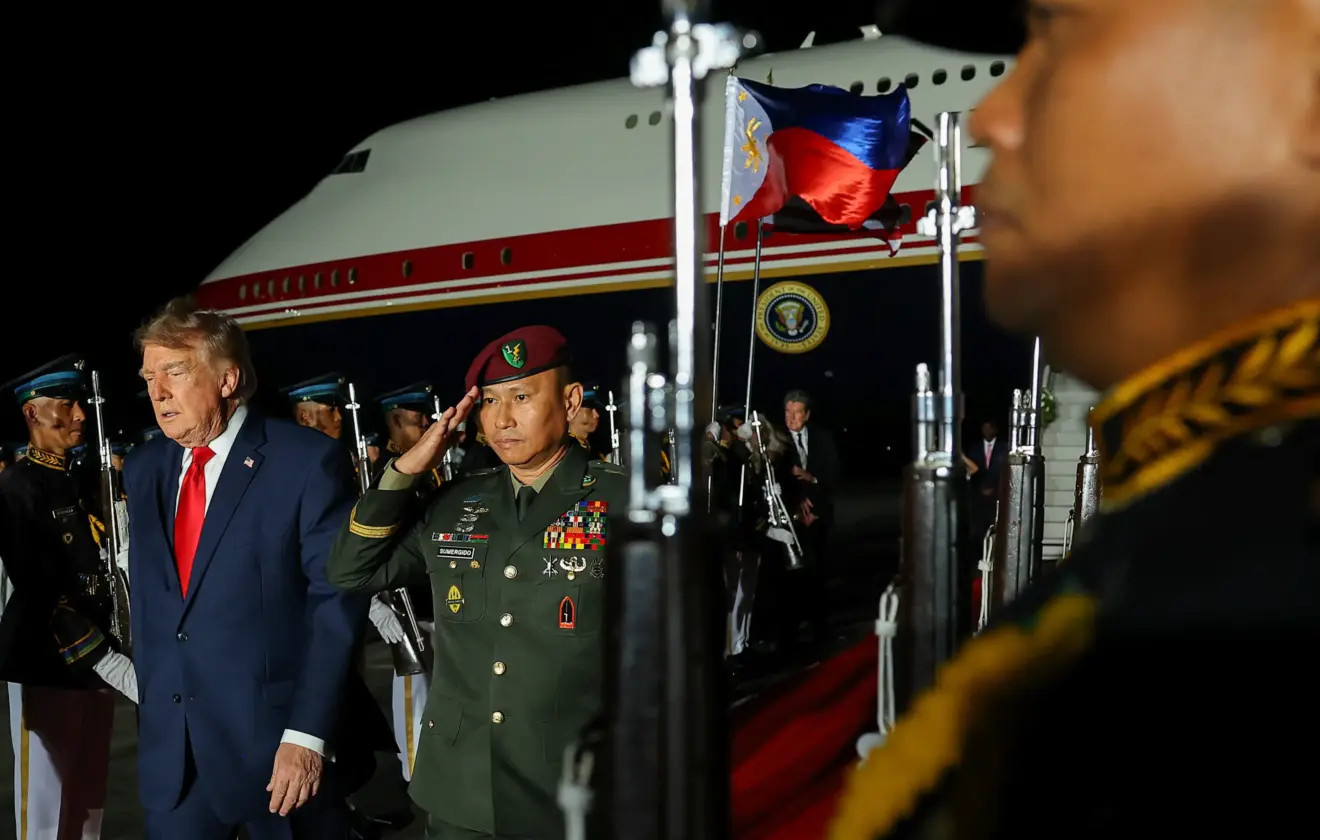
MANILA, Nov 17 – President Donald Trump arrived in Manila on Tuesday afternoon as the Southeast Asian summit drew to a close, greeted by street protests and facing a packed agenda that included his first meeting with the Quad group of Indo-Pacific countries.
The Quadrilateral Security Dialogue brings together the United States, Japan, Australia and India. It hasn’t met at the leaders’ level in two years. Trump’s predecessor, Joe Biden, saw the group as one of his main foreign policy achievements.
After the Quad meeting, Trump will join a special summit with leaders of the Association of Southeast Asian Nations later on Tuesday.
Trump’s Asia trip comes right after his Republican Party lost the midterm elections this month. He’s also facing spy allegations linked to Nvidia, and new United States limits on China’s access to artificial intelligence chips that could strain a fragile trade truce with Beijing.
The trip also includes the Asia-Pacific Economic Cooperation forum in Shenzhen, China, and a closely watched three-way meeting with the leaders of China and Russia on Thursday.
In Manila, demonstrators gathered for a fifth day of protests. They’ve burned effigies of Trump. They’ve called for an end to the war in the Middle East and for the scrapping of Pax Silica, a supply chain plan led by the United States.
Chinese President Xi Jinping, the host of the forum in Shenzhen, had objected to the Quad. Beijing sees it as an effort to box China in. Quad members say the group isn’t aimed at any one country.
Kurt Campbell, a former deputy secretary of state, said Secretary of State Marco Rubio deserves credit for bringing the group back together. Campbell said the Quad had lost some of its drive under Trump.
He said Rubio sees the meeting as “probably the best possible signal” before the three-way talks with China and Russia.
Campbell, who co-founded the consulting firm The Asia Group, also stressed the importance of Japan. He said the relationship between the United States and Japan is the linchpin of Washington’s work in Asia, and that any sign it isn’t a top priority for Trump would worry him.
White House spokesperson Olivia Wales said on Friday that under Trump, the Quad has shown it is “a partnership of action.” She said it is taking on the region’s hardest problems.
A Japanese foreign ministry official said the leaders were expected to show unity, with maritime security, export limits, critical minerals and artificial intelligence all likely to come up.
Undersea cables, new technology and disaster relief were also likely to be discussed, according to a source familiar with the plans.
On Monday, Chinese Premier Li Qiang praised what he called the “truly extraordinary” economic gains made by China and the Southeast Asian bloc despite global trade barriers. He said Beijing is committed to free trade.
He urged the region to “stand united, ward off interference, and work together,” Li said.
China is the bloc’s largest trading partner and a key investor. The bloc’s 11 members have a combined economic output of more than $3.9 trillion. Still, its biggest economies want closer ties with the United States, despite long-running trade and diplomatic uncertainty under Trump.
Southeast Asian leaders also held talks on Tuesday with the leaders of Japan, South Korea, China and India.
Japanese Prime Minister Sanae Takaichi pledged to work with the bloc to strengthen its economic and energy resilience. She said Japan will help the region address export restrictions and the risks posed by rapidly advancing artificial intelligence, while building stronger supply chains, including for critical minerals.
“Japan will play an ever more proactive role,” Takaichi said.
Trump is also set to sign a joint statement with Thai Prime Minister Anutin Charnvirakul on Tuesday on a reciprocal trade deal. Thai media have reported that the statement will cover progress in the talks.
The United States is Thailand’s largest export market. It takes 24% of Thailand’s total shipments this year. In 2003, Washington named Thailand a major ally outside the North Atlantic Treaty Organization.
On Wednesday, Trump will meet Philippine President Ferdinand Marcos Jr. before flying to Shenzhen.