Hegseth Reassures Southeast Asia on Indo-Pacific Commitment
Defense Secretary Pete Hegseth told Southeast Asian counterparts in Cebu that Washington will defend its interests and those of its partners. He proposed a new framework for defense cooperation.
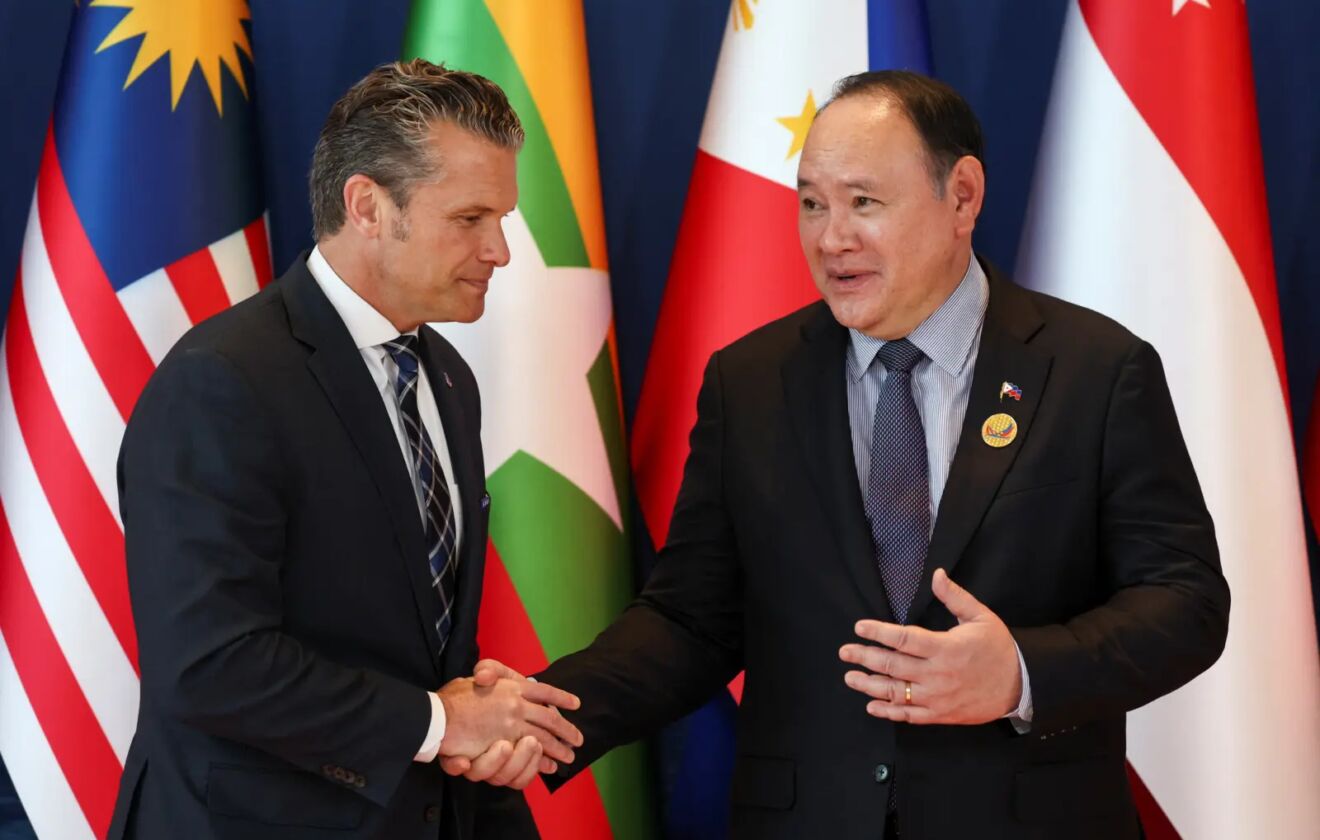
Defense Secretary Pete Hegseth sought on Wednesday to reassure Southeast Asia that Washington remains committed to the Indo-Pacific, pledging that the United States would defend both its own interests and those of its allies and partners in the region.
Hegseth is taking part in two days of defense ministers’ meetings in Cebu hosted by the Association of Southeast Asian Nations. He said the commitment would come with practical steps. These include better awareness of activity at sea, closer coordination between military forces and more cooperation among navies.
“These are not symbolic things,” he said. “They are concrete demonstrations of what serious partners do.” Serious partners, he added, train together, learn together and plan together. That builds the confidence and skill needed to prevent conflict.
He described the American approach as “strong, quiet and clear.” It would be strong enough to deter coercion and aggression, he said. It would be quiet enough to avoid needless escalation or public theatrics.
And it would be clear enough that friends and possible adversaries understood where Washington stands. “We will defend our interests and the interests of our allies and partners,” Hegseth said. “That is, by definition, peace through strength.”
He also proposed. Hegseth suggested that the United States and the regional bloc work out a framework for defense cooperation to guide ties over what he called the critically important next several years.
The two sides mark 50 years of formal relations next year. He said Washington is ready to begin talks with Singapore’s defense minister, Chan Chun Sing, as Singapore prepares to take over the chair of the wider defense ministers’ forum that includes partner countries. Hegseth acknowledged that the two sides won’t always agree on every issue, but said shared interests give them a base for practical work.
The trip comes at a delicate time. Governments across Southeast Asia and the wider region are asking whether Washington can stay focused on Asia while the war with Iran strains its military and creates political pressure at home.
That war began on February 28 with American and Israeli strikes. It has disrupted global shipping and oil markets. For Southeast Asia, it has shown how exposed the region is to shocks in the price of imported fuel, and it has pushed energy security higher on the bloc’s agenda.
China is the other issue in the room. The Philippines, the host and this year’s chair of the bloc, is a treaty ally of the United States. Its relations with Beijing have worsened after repeated clashes in the disputed South China Sea, Chinese sanctions and, more recently, the summoning of the Chinese ambassador.
China claims nearly all of the sea. The Philippines, Vietnam and Malaysia claim parts of it. Days before the meeting, the Philippine military said it had tracked and shadowed China’s Liaoning aircraft carrier group as it passed through waters off the southern Philippines toward the Celebes Sea. China’s defense attaché in the Philippines will attend the meeting, according to its defense ministry.
Greg Poling, who directs the Asia Maritime Transparency Initiative, said Hegseth would have a chance to address China, the South China Sea and Washington’s commitments to its treaty allies.
He said stronger signals were more likely in talks among like-minded partners. One such group is the “Squad,” an informal grouping of the United States, Japan, Australia and the Philippines. Their defense chiefs are due to meet on Wednesday. On Thursday, Hegseth will join an expanded meeting of the bloc’s 11 members and eight partners, which include Australia, China, India, Japan, New Zealand, South Korea and Russia.
Few expect a sharp outcome from that session. Collin Koh, a security scholar at the S. Rajaratnam School of International Studies in Singapore, said the final chairman’s statement would probably be more restrained than the talks behind closed doors, on the bloc’s familiar language. The Philippines is in an especially sensitive spot, he added, since it chairs the group while locked in a dispute with China.
Poling said the Philippines has had to balance hopes for cooperation on energy links, the digital economy and coast guard work against rising tension with China and a stalled effort to agree a code of conduct in the South China Sea.
“For the Philippines, the whole chair year has been a difficult balance,” he said. He expected practical cooperation on the defense ministers’ work streams, but no shared strategy on the South China Sea or other thorny issues.