Jio Platforms Shares Jump 21% in Mumbai Debut, Making It India’s Second-Largest Company
Shares of Jio Platforms rose 21 percent on their first day of trading in Mumbai. The telecom giant is now India’s second-largest company by market value, at about $131.5 billion.
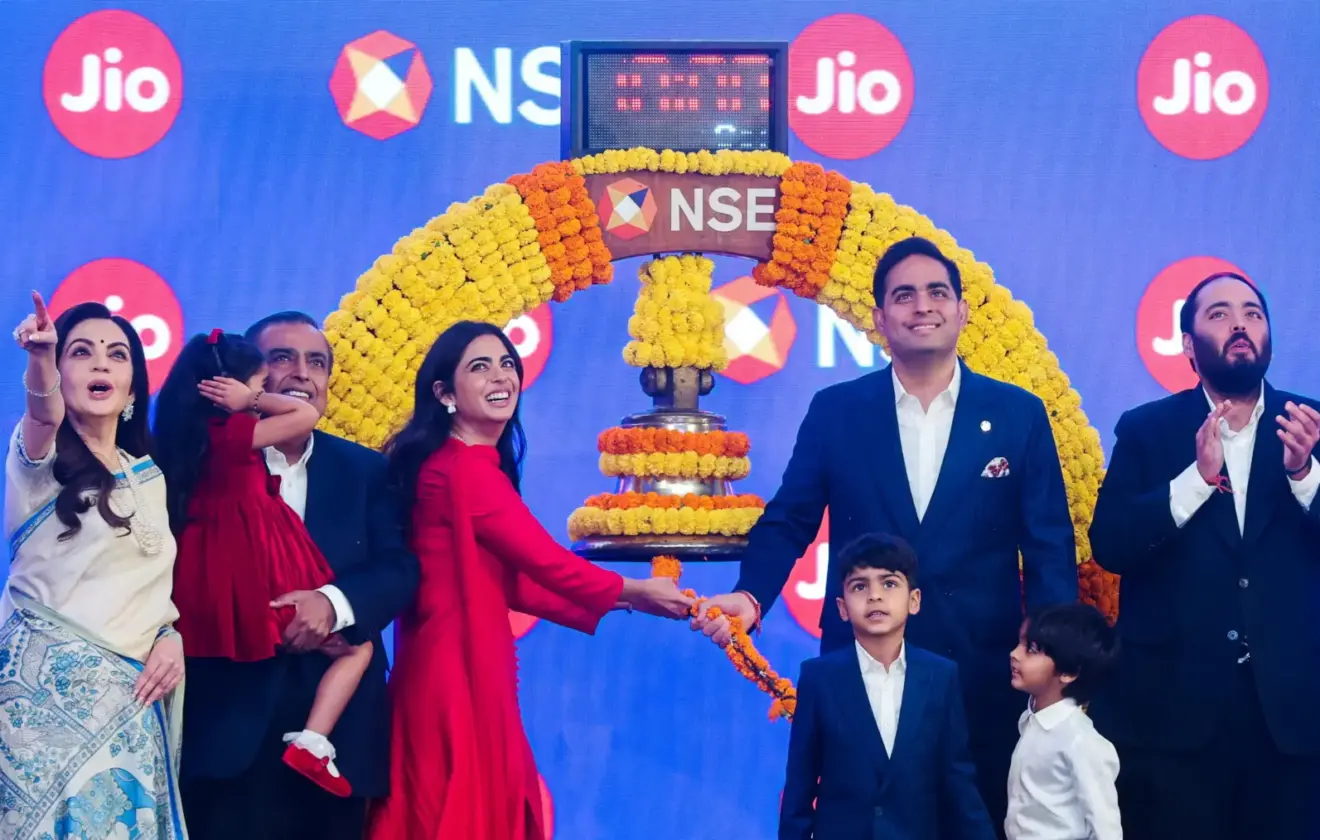
Shares of Jio Platforms, the telecoms and digital arm of billionaire Mukesh Ambani’s Reliance group, soared 21 percent in their Mumbai debut on Wednesday. The jump made it India’s second-largest company by market value, at about $131.5 billion.
The stock opened at 1,358 rupees a share, well above its offer price of 1,119 rupees, giving Jio a strong start on its market debut. The company’s market value quickly passed those of Bharti Airtel and HDFC Bank, placing it behind only its parent, Reliance Industries, among Indian companies by valuation.
The offering raised about 30,213 crore rupees, the largest in India’s history, and attracted overwhelming demand, with bids exceeding the shares on sale by more than 22 times. It marks the first stock market listing for the Reliance group in two decades. Mukesh Ambani is a step closer to his plan to transform Reliance from an oil and chemicals business into what he calls an “everything company,” with a growing presence across consumer products, retail, and technology.
Jio’s telecoms arm serves more than 530 million customers and counts Meta Platforms and Alphabet’s Google among its backers. Measured by subscribers within a single country, only China Mobile has more, underscoring the scale of Jio’s reach in one of the world’s fastest-growing digital markets.
The listing ceremony drew members of the Ambani family, turning the event into both a financial milestone and a public display of the group’s next generation. Mukesh Ambani’s eldest son, Akash, who serves as Jio’s managing director, touched his parents’ feet before walking to the stage, a traditional gesture of respect that drew attention from those gathered at the exchange.
All three of the Ambani children spoke during the ceremony, each framing the listing as the beginning of a new chapter for the family business. Their speeches highlighted Jio’s growth from a telecom operator into a broader digital and consumer platform, while also signaling the role the younger generation is expected to play as Reliance expands beyond its traditional oil and chemicals base.
Mukesh sat in the audience, visibly moved and in tears. His youngest son, Anant, traced the history of Reliance and Jio. The family later rang the bell on stage at the National Stock Exchange and posed for photographs beside the exchange’s bull statue, where people waved flags with the Jio logo.
The family’s succession has been a long project. Ambani is Asia’s richest person, according to Forbes. He has spent years on a plan meant to avoid a repeat of the public feud with his younger brother, Anil, that followed the death of their father, Dhirubhai, in 2002. Dhirubhai died without a will. Reliance is hosting a celebration for staff at its large office near Mumbai, according to an internal memo, with music sessions and other performances.
Investors responded warmly. “The IPO price offered a valuation entry point,” said Aishvarya Dadheech, founder of Fident Asset Management, “the listing price reflects a much greater degree of optimism.” Kranthi Bathini, an equity strategist at WealthMills Securities, said Jio had a strong debut despite geopolitical issues and choppy markets. From here, he said, revenue and earnings will drive the stock.
Several brokerages see room for the shares to rise further. They also pointed to risks. These include competition, heavy spending on equipment and networks, and changes to India’s telecom rules, including those covering spectrum, licensing and fees. Major Indian newspapers carried front-page advertisements from Reliance Jio on Wednesday with a simple message: “Thank you, India.”
The deal also lifts India’s standing in the global market for new listings. Data from the exchange group LSEG shows India has had the most listings in the world this year, with 246 so far. By money raised, it ranks fourth at $13.5 billion, behind the United States, mainland China and Hong Kong. Adding the Jio offering would move India past Hong Kong’s $15.4 billion, according to Reuters calculations.
The bankers did not receive a record payday, as the 19 banks working on the deal will share about $20.7 million, or 0.65 percent of the offering. That is roughly half the 1.3 percent fee that sources said Hyundai Motor India paid its bankers for its 2024 listing, reflecting the intense competition among banks to win a role on India’s largest-ever share sale.
The Ambanis have a long record with the stock market. Dhirubhai took Reliance public in 1977 with an offering aimed at small retail investors, a move widely credited with helping to build India’s equity culture. Investors have rewarded the group since. Reliance Industries has returned about 900 percent since 2006, outpacing the 685 percent gain of the Nifty index, according to LSEG data, a performance that has made the company one of India’s most trusted long-term investments for small shareholders.
Many small investors continue to treat it as a buy-and-hold stock, viewing the company’s scale and diversification as a long-term bet on India’s economic growth.