Melenchon Under Fire: France Unbowed Blamed as France Unrest Deepens
Politicians across the spectrum accuse the hard-left leader of fueling the worst civil unrest in years, and some now ask whether his party should be banned, while he points to neglected suburbs.
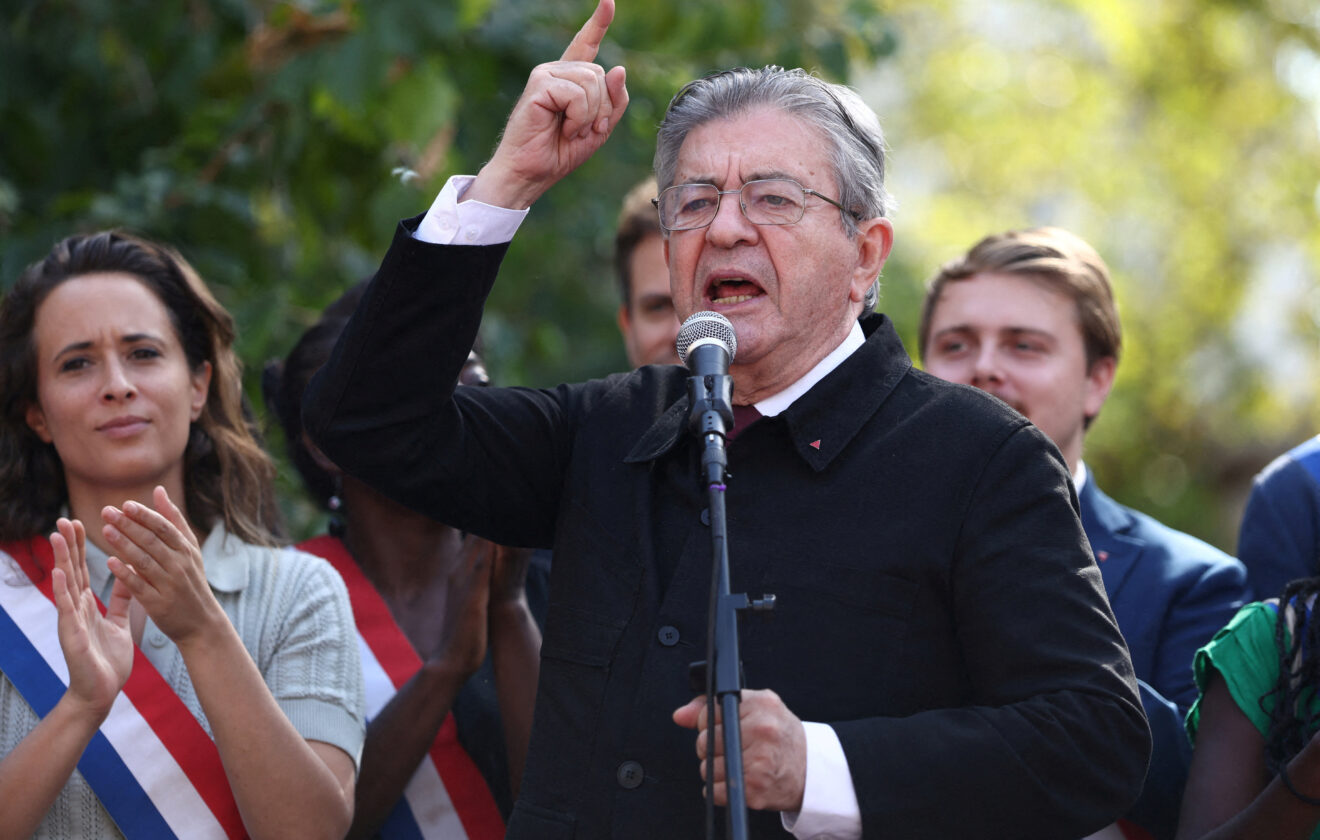
With criticism coming from rivals across the political spectrum, from the centre-left to the far right, Jean-Luc Mélenchon’s France Unbowed party is facing increasing blame for France’s worst civil unrest in years.
Jean-Luc Melenchon launched his fourth run for the presidency in May. He is still the hard left’s best chance of reaching next year’s run-off. The trouble started in late September with student protests, and it has since spread to several cities, mostly in poorer suburbs. His opponents say the party’s years of confrontational rhetoric helped set the stage.
Prime Minister Sebastien Lecornu made that case directly on Tuesday, October 20. He told a France Unbowed lawmaker that the party’s “political agenda of instilling violence and chaos in the country was now on full display.” The Saturday before, with Paris streets burning and shops being looted, he had said everyone needed to pick a side: the Republic and its security forces, or the agitators and the far left. He has pointed to an intelligence report from late September to back his criticism, and he has called the unrest a warm-up for the presidential race.
Mélenchon says none of this is his party’s doing. In his view, the government let social and economic grievances in the poorer suburbs pile up, and now it wants someone to blame.
The attacks are coming from more than one direction. Gerard Larcher, the Senate president, told Le Figaro that a ban on France Unbowed thoughts. The party called that authoritarian. Bruno Retailleau, who is running for the traditional right, has made a similar demand. The party holds 71 seats in the National Assembly, and a ban would be no small matter.
Laurent Jacobelli, a spokesperson for Marine Le Pen’s National Rally, blamed “the ultra-left, including France Unbowed,” along with uncontrolled immigration, for what he called a revolutionary climate. Marc Fesneau, of the centrist MoDem party, said Mélenchon had long pushed the idea that “everything must be a battleground.”
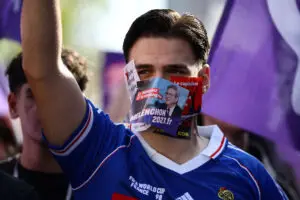
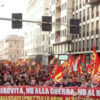
A supporter of Jean-Luc Melenchon, leader of French far-left opposition party La France Insoumise (France Unbowed – LFI) and candidate for the 2027 French presidential election, wears stickers on his face during a demonstration by French high school and university students in Paris as part of a nationwide protest movement led by students, supported by teachers, school parents and labour unions, demanding better school conditions and concrete measures, France, October 13, 2026. REUTERS
Not everyone is buying the government’s account. This week the investigative outlet Mediapart quoted an intelligence officer who said officials had been told to describe France Unbowed as the force behind the student movement, even though local intelligence did not back that up. The government denied it.
The politics of all this favor Le Pen. She has taken a calm, presidential tone on law and order, a subject that has long worked for the far right, while attention falls on the hard left. In an IFOP poll for the broadcaster LCI this month, she stood at 36 percent and Melenchon at 16.5, still ahead of every other mainstream candidate. OpinionWay, polling for Les Echos, gave Le Pen 32 percent. It also found Melenchon leading among voters aged 18 to 24 with 49 percent, up 10 points from 2022. Another survey, by Cluster17, found that nearly half of voters aged 18 to 24 and more than a third of those aged 25 to 34 would vote for him.
Those numbers explain why he has become a voice for many of the students in the streets. They also point to his weak spot. Frederic Dabi, who heads IFOP, said that many older voters see Melenchon as too relaxed about violence, and that this is a serious obstacle for him. His strength lies elsewhere, in poorer urban neighborhoods and among voters from immigrant families, who like his idea of a “New France” that is multicultural and gives more political voice to people who feel ignored. Hadrien Clouet, one of the party’s lawmakers, said it offers radical change together with a real plan for governing, aimed at inequality and at the decades in which, in the party’s view, wealth has drifted toward finance and a small elite.
His choice of words keeps drawing fire. In the 2023 pension fight, he urged supporters to “tear down the citadel” of President Emmanuel Macron’s government. At other times he has spoken well of “citizen insurrection.” His supporters say he means mass political mobilization, not violence, and they note that the party officially favors non-violent action. Sylvain Maillard, of Macron’s Renaissance party, said France Unbowed claims to oppose vandals while defending the wearing of masks at demonstrations, and that it keeps blaming the police instead of calming things down.
Former Socialist President Francois Hollande urged the country not to turn the debate into a case against one man. He faulted France Unbowed for sometimes treating violence by rioters and violence by police as the same thing, but said it would be a mistake to look only at one party. “It is not one political party or one individual that poured fuel on the fire,” he told the radio station France Inter.
Macron has asked Lecornu to gather students, teachers, unions and elected officials and come back in the next few days with proposals. He has also promised a tougher response to violence. With the French unrest still going and the political field split three ways, Melenchon under fire is likely to remain a feature of the campaign.